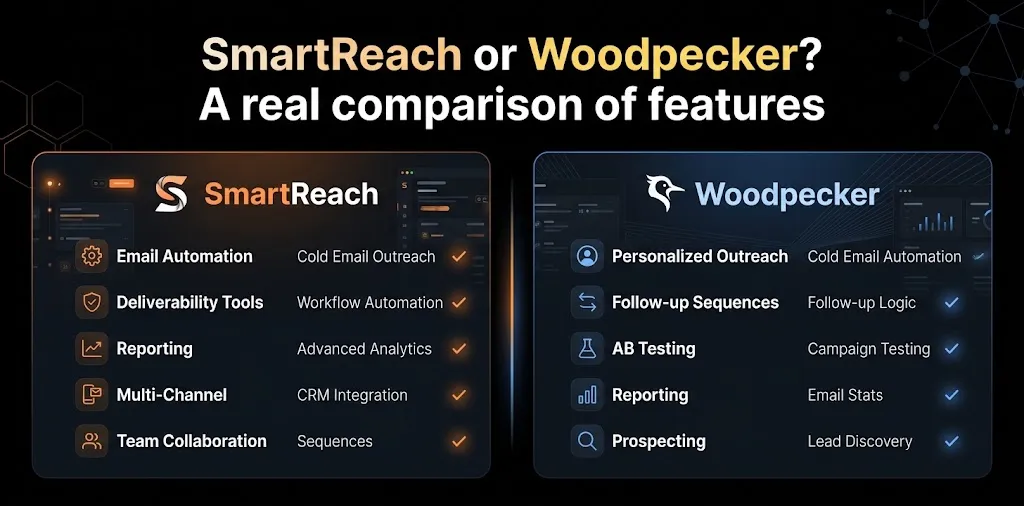
SmartReach or Woodpecker? A real comparison of features

SmartReach and Woodpecker are both built for cold email outreach, but they take different approaches. SmartReach is the broader sales engagement platform, with email, LinkedIn, calling, prospecting, AI automation, and CRM workflows. Woodpecker focuses more tightly on cold email, deliverability, personalized sequences, and simple outbound campaigns. For email-first outreach, Woodpecker is easier to keep focused; for multichannel sales, SmartReach offers more built-in tools.
If you’re deciding between the two, the biggest question is not which platform has more features. It is which features match the way you actually plan to run outreach.
SmartReach vs Woodpecker at a glance
| Feature | SmartReach | Woodpecker |
|---|---|---|
| Cold email campaigns | Yes | Yes |
| Automated follow-ups | Yes | Yes |
| Email warm-up | Yes | Yes |
| Email verification | Yes | Yes |
| Inbox rotation | Yes | Yes |
| A/B testing | Up to 5 variants | Up to 5 variants |
| LinkedIn outreach | Yes | Yes |
| Calling | Yes | Manual call tasks and integrations |
| Guided tasks | No comparable native workflow | |
| Lead database | 300M+ contacts | Lead Finder available |
| AI email generation | Advanced AI features | AI writing assistant |
| AI reply classification | Yes | Yes |
| CRM integrations | Salesforce, HubSpot, Pipedrive, Zoho and more | HubSpot, Pipedrive and others |
| Agency features | Strong | Strong |
| Unified inbox | Yes | Yes |
| Prospect timezone sending | Yes | Yes |
| Deliverability monitoring | Yes | Yes |
| Adaptive sending | Yes | Yes |
| Pricing model | Starts at $29/month for Email Outreach | Starts at $35/month based on contacted prospects |
| Best fit | Multichannel sales teams and agencies | Cold-email-focused users and teams |
The two products overlap heavily in core outreach functions. The difference becomes clearer when you look beyond basic email sending.
SmartReach vs Woodpecker: what’s actually different?
At a basic level, both tools can build prospect lists, connect sending accounts, create sequences, automate follow-ups, monitor replies, and help protect email deliverability.
The bigger difference is product scope.
SmartReach is designed as a broader sales engagement platform. Its current feature set covers cold email, LinkedIn, calling, WhatsApp tasks, prospecting, AI automation, CRM synchronization, team management, and agency workflows.
Woodpecker is more email-outreach focused. Its strongest areas include cold email automation, inbox rotation, warm-up, verification, deliverability controls, condition-based campaigns, and personalized one-to-one outreach.
That distinction matters because extra features are useful only if you will actually use them.
Email outreach and campaign automation
Both platforms are strong for automated cold email.
You can create multi-step campaigns, personalize messages, schedule follow-ups, and stop sequences when prospects respond.
SmartReach adds a wider set of sales engagement features around those campaigns. Its platform includes conditional multichannel sequences and can combine email with LinkedIn and calling activities.
Woodpecker keeps the experience more centered around email. Its condition-based campaigns can change follow-ups based on prospect behavior, while its automation can handle replies, out-of-office messages, and other common outreach events.
Which is better for email automation?
For pure cold email, the difference is relatively small.
Woodpecker may be the better choice if your process is:
- Import prospects.
- Write a personalized email sequence.
- Send emails gradually.
- Automate follow-ups.
- Handle replies.
SmartReach makes more sense if the process is closer to:
- Find prospects.
- Send an email.
- Contact them on LinkedIn.
- Make a call.
- Trigger another action based on their response.
- Sync everything with the CRM.
In other words, Woodpecker keeps email at the center, while SmartReach tries to make email one part of a larger sales workflow.
Deliverability features
Deliverability is one of the most important parts of any cold-email platform, and both products put significant attention on it.
SmartReach offers email warm-up, inbox rotation, email verification, ESP matching, sending throttling, spam monitoring, domain health tools, and blacklist monitoring.
Its inbox rotation system can distribute sending across multiple email accounts and domains. SmartReach also supports matching sending infrastructure to recipient email providers, such as Gmail-to-Gmail or Outlook-to-Outlook.
Woodpecker also has a strong deliverability toolkit. Its current features include free warm-up, inbox rotation, deliverability monitoring, adaptive sending, randomized sending intervals, domain audits, spam checks, and email verification.
Is one better for deliverability?
There isn’t a reliable reason to say that one platform will automatically get every user’s emails into the inbox more often.
Your domain reputation, sending volume, email quality, authentication, list quality, complaint rate, and recipient engagement all matter.
However, SmartReach has more deliverability controls, while Woodpecker makes many of its deliverability tools easy to access within a focused cold-email workflow.
If you like having more controls, SmartReach has an advantage.
If you want a straightforward email-first system, Woodpecker remains attractive.
Personalization
Personalization is important because cold email works poorly when every prospect receives the exact same message.
Both platforms support personalization through prospect data and custom fields.
Woodpecker offers snippets, spintax, prospect timezone sending, and AI-assisted email writing. It also supports sending emails individually with randomized timing to make campaigns feel less like bulk blasts.
SmartReach goes further with advanced personalization options, including merge tags, spintax, liquid syntax, prospect data, and AI-generated messages.
Its Smart Email AI Agent can generate individual emails using available prospect information such as company, job title, location, industry, and other enriched data.
Which has better personalization?
SmartReach wins for advanced personalization.
Woodpecker is still capable of highly personalized campaigns, especially if you prefer to control your templates yourself.
But if you want the platform to use prospect data to generate different messages at scale, SmartReach has the stronger feature set.
A/B testing
Both tools support A/B testing, and neither has a major advantage here.
SmartReach allows you to test up to five email variants. You can compare different subject lines or email content and use campaign reporting to see which version performs better.
Woodpecker also supports up to five message versions.
For example, a sales agency could test:
- Version A: short question-based subject line
- Version B: benefit-focused subject line
- Version C: personalized company reference
The important part is not having five versions. It’s having enough sends to make the comparison useful.
Winner: Tie
Both platforms give you enough testing capability for most cold-email campaigns.
LinkedIn and multichannel outreach
This is where SmartReach starts to separate itself.
SmartReach supports email, LinkedIn, calling, and WhatsApp-related tasks within its broader sales engagement platform. Its multichannel workflows are designed to coordinate different outreach actions instead of treating each channel as a separate campaign.
Woodpecker also supports multichannel outreach. You can combine email with LinkedIn tasks and phone calls, including LinkedIn automation through its integration with Dux-Soup.
However, Woodpecker’s core identity remains centered on cold email.
Winner: SmartReach
If your strategy includes several channels, SmartReach has the more extensive native sales engagement approach.
If LinkedIn is only an occasional addition to your email campaigns, Woodpecker may still provide everything you need.
Lead generation and prospecting
This is another important difference.
SmartReach now includes a large B2B contact database and prospecting tools inside the platform. Its current platform advertises access to more than 300 million contacts and 50 million companies, along with filters for things such as job title, seniority, industry, company size, revenue, technology, and location.
That means you can potentially handle more of the prospecting workflow without moving between several platforms.
Woodpecker also offers Lead Finder functionality, but its traditional strength is the outreach side rather than being an all-in-one prospect database.
Winner: SmartReach
SmartReach is more appealing if you want prospecting + enrichment + outreach in one environment.
If you already use a separate lead database, this advantage may matter less.
AI features
Both platforms use AI, but SmartReach currently has a broader AI layer.
SmartReach offers AI-powered campaign creation, personalized email generation, reply classification, sentiment analysis, out-of-office handling, and other automation features.
Its Smart Email AI Agent can create individualized messages for prospects based on the data available to the system.
Woodpecker has an AI email writing assistant and AI-based interest-level detection. It can identify interested replies and help reduce the amount of manual reply sorting.
Winner: SmartReach
SmartReach has the stronger AI feature set overall.
That doesn’t necessarily mean its AI-written emails will always be better. Good prospect data and a strong offer still matter more than the presence of an AI button.
CRM and integrations
Both platforms integrate with common business tools.
SmartReach supports CRM connections such as Salesforce, HubSpot, Pipedrive, and Zoho, along with Zapier, API, and webhooks.
Woodpecker integrates with tools including HubSpot, Pipedrive, Calendly, Zapier, Google Sheets, and other services. It also provides API and webhook capabilities.
If your sales team already lives inside a CRM, check the exact integration and sync behavior you need before choosing.
Winner: SmartReach for larger sales stacks
SmartReach has a broader native CRM and sales-engagement approach.
Woodpecker is still a good choice if your integration needs are centered around a smaller set of sales tools.
Agency features
Both platforms can work for agencies managing outreach for multiple clients.
SmartReach offers agency dashboards, client management, roles, permissions, and multi-client workflows. Its current plans are designed to let agencies manage clients from a centralized environment.
Woodpecker also has an Agency Panel, client access controls, separate account data, and centralized management features.
Which is better for agencies?
This depends on what the agency sells.
A cold-email agency may find Woodpecker’s focused workflow sufficient.
An agency offering email + LinkedIn + calling + prospecting may get more value from SmartReach because more of the sales process can be handled inside one platform.
Pricing comparison
Pricing is one area where you need to look beyond the starting number because the platforms use different pricing structures.
SmartReach’s Email Outreach plans currently start at $29 per month for Basic. Its Plus plan is $89/month, Pro is $199/month, and Scale is $499/month. The plans are based mainly on active prospects rather than charging for every individual sending inbox.
Woodpecker currently prices its core service around contacted prospects. Its pricing page shows a starting calculation of about $35/month for 500 contacted prospects, with the exact bill depending on the selected volume and billing period.
| Pricing factor | SmartReach | Woodpecker |
|---|---|---|
| Entry price | $29/month | About $35/month at the displayed starting paid level |
| Sending inbox fees | No per-inbox fee on Email Outreach plans | Unlimited email accounts included |
| Warm-up | Included, with plan limits | Included, with some limits/add-ons |
| Email verification | Included | Included |
| Unlimited sending | Available on paid plans | Follow-ups and email accounts are not charged separately |
| Available/add-on depending on setup | Available | |
| Agency tools | Higher-tier plans | Agency features/add-on structure |
| Pricing metric | Active prospects | Contacted prospects |
Because the pricing models are different, simply asking which is cheaper can be misleading.
A better question is:
How many prospects will you contact, how many sending accounts will you use, and which extra channels do you need?
For a small email-only campaign, either can be reasonably priced. As your workflow becomes more complex, SmartReach’s plan structure can become attractive because sending inboxes aren’t priced individually.
Ease of use
Woodpecker has an advantage in simplicity.
Its product is focused on cold outreach, so a new user can understand the main workflow quickly: connect an inbox, create a campaign, add prospects, and start sending.
SmartReach has more capabilities, but that also means there is more to learn.
If you’re a solo founder who only needs cold email, SmartReach’s larger feature set could feel unnecessary.
If you’re running a sales team with several channels, those additional controls can save you from stitching together multiple tools.
Winner for simplicity: Woodpecker
Winner for broader functionality: SmartReach
Two practical examples
Example 1: A small consulting business
Imagine a small U.S. consulting company that sends 300 to 500 highly personalized emails each month.
The team already has a CRM, a lead source, and a separate LinkedIn workflow. They mainly need reliable cold-email sequences, automatic follow-ups, verification, and deliverability tools.
Woodpecker would likely be the more sensible choice.
The team doesn’t need a large sales engagement platform if email is already the main workflow.
Example 2: A lead generation agency
Now imagine an agency managing outbound campaigns for several clients.
The agency wants to find prospects, personalize messages, rotate multiple inboxes, contact prospects through LinkedIn, make calls, classify replies, and keep client activity organized.
SmartReach would likely make more sense.
The broader platform can reduce the number of separate tools required to run that workflow.
SmartReach vs Woodpecker: the main trade-off
The real choice can be summarized like this:
Woodpecker gives you a focused cold-email system. SmartReach gives you a broader outbound sales system.
That difference affects almost every part of the decision.
Choose Woodpecker when you value:
- A focused cold-email workflow
- Strong deliverability controls
- Simple campaign management
- Personalized one-to-one outreach
- Automated follow-ups
- Email-first prospecting
- A less complicated interface
Choose SmartReach when you need:
- Email and LinkedIn outreach
- Calling workflows
- Built-in prospecting
- Advanced AI automation
- More advanced personalization
- Broader CRM connectivity
- Agency and team management
- A larger sales engagement platform
Which one should you choose?
For cold email alone, I would lean toward Woodpecker.
Its feature set is well aligned with the core job: sending personalized outbound emails, managing follow-ups, monitoring replies, and protecting sender reputation.
For multichannel outbound sales, I would choose SmartReach.
Its broader feature set makes more sense when email is only one part of your prospecting process.
The important thing is not to pay for features you won’t use. A platform with 100 features isn’t better for a business that needs five.
Frequently asked questions
Is SmartReach better than Woodpecker for cold email?
Not necessarily. Woodpecker is highly focused on cold email and offers strong automation and deliverability features. SmartReach becomes more attractive when you also need prospecting, LinkedIn, calling, AI automation, and broader sales workflows.
Which is easier to use, SmartReach or Woodpecker?
Woodpecker is generally the simpler option because its core workflow is centered on cold email. SmartReach has more capabilities, so it may take longer to learn, but those additional tools can be useful for teams running more complex outbound campaigns.
Can SmartReach and Woodpecker both automate follow-up emails?
Yes. Both platforms support automated multi-step email campaigns and follow-ups. They can also use prospect behavior and replies to control what happens next, although the exact automation options differ between the two products.
The bottom line
Pick Woodpecker if your main goal is reliable, personalized cold-email outreach. Pick SmartReach if you want a broader sales engagement platform that combines email with prospecting, LinkedIn, calling, AI, and CRM workflows.
Before choosing, map out your actual outreach process from finding a prospect to getting a reply. If email is most of that process, Woodpecker’s focused approach is hard to ignore. If several channels are involved, SmartReach’s broader feature set is likely worth the extra complexity.