Apollo or Lemlist? A real comparison of features

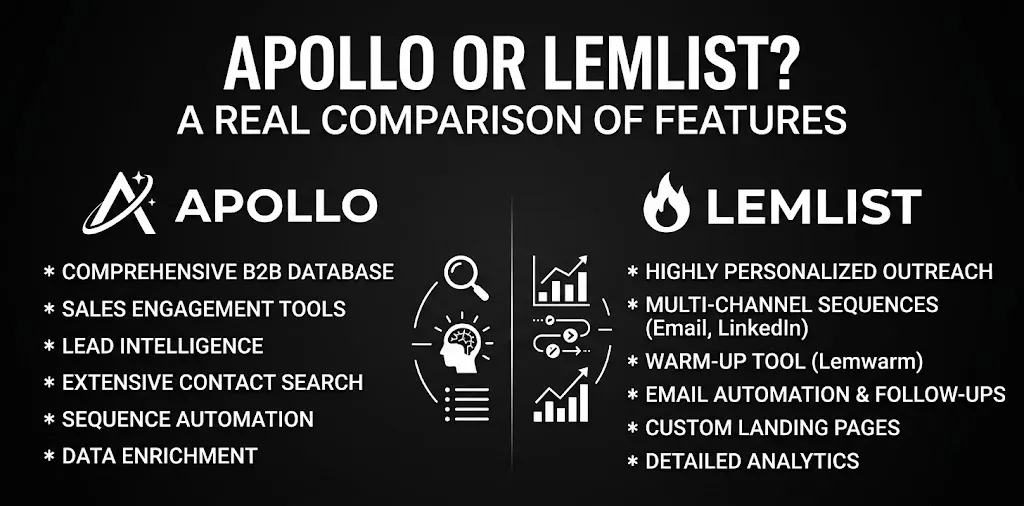
Apollo and Lemlist both help B2B teams find prospects and run outbound campaigns, but they are built around different priorities. Apollo is broader, combining a large B2B database, prospecting, enrichment, sales engagement, calling, AI, and CRM workflows. Lemlist puts more emphasis on personalized multichannel outreach, deliverability, and campaign automation.
If you mainly need prospecting data plus outreach in one platform, Apollo is the stronger all-around choice. If your leads are already sourced and you care more about personalized email, LinkedIn, calling, and deliverability-focused campaigns, Lemlist can be a better fit.
Apollo vs Lemlist at a Glance
| Feature | Apollo | Lemlist |
|---|---|---|
| Main focus | B2B prospecting + sales engagement | Multichannel outbound + personalization |
| B2B database | 240M+ contacts, 30M+ companies | 650M+ lead database claimed |
| Email finder | Yes | Yes |
| Phone data | Yes | Yes |
| Email sequences | Yes | Yes |
| LinkedIn outreach | Yes | Yes |
| Calling | Native dialer | In-app calling/VoIP |
| SMS | Limited compared with Lemlist | Yes |
| Not a core channel | Available as an add-on | |
| Email warm-up | Yes | Yes |
| AI research | Yes | Yes |
| AI personalization | Yes | Yes |
| Data enrichment | Strong | Available through credits |
| CRM workflows | Strong | Stronger at higher tiers |
| Free option | Yes | Yes |
| Best for | Prospecting + outbound in one system | Personalized multichannel outreach |
The biggest difference is simple: Apollo is more of an all-in-one GTM platform, while Lemlist is more focused on executing personalized outbound campaigns.
What Is Apollo?
Apollo is a B2B sales and go-to-market platform that combines prospecting data with sales engagement tools.
Its database currently contains more than 240 million contacts and 30 million companies, with filters for building targeted prospect lists. Apollo also provides email and phone data, enrichment, sequences, intent signals, workflows, calling, and AI features.
That combination matters because you don’t necessarily need one tool to find prospects and another to contact them.
For example, a sales rep could:
- Search for U.S. companies in a specific industry.
- Filter contacts by job title and seniority.
- Find business emails and phone numbers.
- Add prospects to a sequence.
- Follow up through email, phone, or LinkedIn.
- Track activity and outcomes.
Apollo is therefore attractive to teams that want prospecting and outreach under one roof.
What Is Lemlist?
Lemlist is an outbound sales platform focused heavily on personalized, multichannel prospecting.
Its current platform combines lead discovery and enrichment with email, LinkedIn, calls, SMS, and WhatsApp outreach. It also emphasizes email deliverability, inbox protection, warm-up, personalization, and conditional campaign steps.
Lemlist is particularly interesting when the quality and personalization of your outreach process matter as much as the number of contacts you can find.
For example, you could create a campaign that:
- Sends a personalized email.
- Waits for a response.
- Visits the prospect’s LinkedIn profile.
- Sends a LinkedIn message.
- Creates a call task.
- Sends another follow-up if the prospect doesn’t respond.
This type of multichannel workflow is one of Lemlist’s strongest areas.
Apollo vs Lemlist: Prospecting and Lead Database
If you need to find prospects from scratch, Apollo has a major advantage.
Apollo provides access to more than 240 million contacts and 30 million companies, along with more than 65 search filters. Those filters can help narrow prospects by factors such as job title, industry, company size, and other attributes.
Lemlist has also expanded its prospecting capabilities and currently advertises a database of more than 650 million leads, along with email and phone finding and enrichment. However, many data-related actions use a credit system.
So the practical difference isn’t simply database size.
Choose Apollo if prospect discovery is a major part of your workflow.
Choose Lemlist if you already have leads or want prospecting tightly connected to personalized outbound campaigns.
Winner for Prospecting: Apollo
Apollo’s prospecting experience is one of its biggest advantages because database search, filtering, enrichment, and engagement are closely connected.
Apollo vs Lemlist: Email Outreach
Both platforms support automated email sequences, follow-ups, scheduling, personalization, and campaign automation.
Apollo’s sequences can combine emails with calls, LinkedIn actions, and other sales tasks. Its AI tools can also help create and personalize outreach.
Lemlist takes a more personalization-focused approach. Its email campaigns support custom text and images, conditional steps, campaign scheduling, automatic launching, and Liquid Syntax for dynamic content.
This distinction becomes important when you’re running campaigns where personalization is central to the strategy.
For instance, a consulting firm sending highly customized messages to 100 carefully selected prospects may get more value from Lemlist’s campaign personalization tools.
A sales team sending outreach to thousands of prospects while also managing prospect data may prefer Apollo’s broader workflow.
Winner for Email Outreach: Lemlist
For teams that care heavily about personalized outbound campaigns, Lemlist has the edge.
Apollo is still very capable, but its larger advantage is the connection between prospecting, data, engagement, and sales workflows.
Apollo vs Lemlist: LinkedIn Outreach
Both platforms can incorporate LinkedIn into outbound workflows, but Lemlist puts more emphasis on LinkedIn as part of its multichannel system.
Lemlist supports LinkedIn profile visits, connection requests, messages, InMails, voice messages, and other LinkedIn-related actions. It also includes smart limits and delays designed around LinkedIn outreach.
Apollo also supports LinkedIn-related actions inside its sales engagement workflows, allowing teams to combine social touches with email and calls.
If LinkedIn is just one part of a broader sales process, Apollo is sufficient.
If your outbound strategy depends heavily on combining email + LinkedIn + personalized touches, Lemlist is more compelling.
Winner for LinkedIn Outreach: Lemlist
Lemlist has a stronger multichannel-outreach orientation, especially for teams that treat LinkedIn as a core part of their campaigns.
Apollo vs Lemlist: Calling
Calling is another area where Apollo stands out.
Apollo offers a native dialer with click-to-call, CRM logging, call recording, and transcription. It also offers a Parallel Dialer designed to help sales reps work through multiple prospects more efficiently.
Lemlist also supports calling. Its current platform includes in-app calling, call tasks, transcription, and integrations with services such as Aircall and Ringover.
The difference is that calling feels more deeply integrated into Apollo’s broader sales platform.
If your SDRs spend a large part of the day making calls, that can make Apollo more attractive.
Winner for Calling: Apollo
Apollo has the stronger native sales-dialing setup.
Apollo vs Lemlist: Email Deliverability
Deliverability matters because an excellent campaign is useless if the messages consistently land in spam.
Apollo provides email warm-up, deliverability scoring, inbox setup guidance, authentication support, and deliverability insights.
Lemlist makes deliverability one of its core selling points. Its platform includes deliverability tools, warm-up, inbox monitoring, and protections intended to help maintain sender reputation.
Neither platform can guarantee inbox placement. Your domain reputation, sending behavior, email quality, authentication, list quality, and recipient engagement still matter.
Winner for Deliverability: Lemlist
Lemlist gets the edge because deliverability is more central to its outbound positioning and workflow.
Apollo vs Lemlist: AI Features
Both platforms have moved beyond basic AI writing tools.
Apollo offers AI research, AI-powered messaging, AI lead scoring, AI sequence building, and other AI-assisted sales workflows. Its platform is increasingly designed around using AI across prospecting and sales execution.
Lemlist has its own AI capabilities through tools such as lemAgent, AI-powered research, lead-data cleaning, enrichment, personalization, and intent signals.
The difference is mostly about where the AI fits.
Apollo uses AI across a broader sales workflow.
Lemlist uses AI heavily around finding context and creating more relevant outbound communication.
Winner for AI: Apollo
Apollo has the broader AI-driven sales platform, while Lemlist remains very strong for AI-assisted outbound personalization.
Apollo vs Lemlist: Data Enrichment
Apollo has a strong advantage if you want enrichment to be a central part of your workflow.
It supports CRM enrichment, CSV enrichment, API enrichment, waterfall enrichment, job-change enrichment, and other methods of keeping prospect information updated.
Lemlist also provides email and phone finding, verification, enrichment, and AI-based data features. However, its current system uses credits for many enrichment and verification actions.
That credit-based approach isn’t necessarily bad. It can give you more control over usage, but you need to understand how much data your campaigns will consume.
Winner for Data Enrichment: Apollo
Apollo is the better fit if data management and enrichment are major parts of your sales operation.
Apollo vs Lemlist: Pricing
Pricing is one area where you need to look beyond the headline monthly number because the plans are structured differently.
Apollo currently has a free plan, followed by Basic at $49 per user per month, Professional at $79, and Organization at $119 per user per month with a three-seat minimum, based on annual billing.
Lemlist’s current pricing is structured differently. Its Email plan starts at $69 per month, or $55 per month when billed annually, with the listed plan supporting unlimited users and 50,000 emails per month. Its Multichannel plan is listed at $109 per user per month, or $87 annually, with LinkedIn and calling features included.
| Pricing factor | Apollo | Lemlist |
|---|---|---|
| Free option | Yes | Yes |
| Entry paid plan | $49/user/month annually | $55/month annually |
| Multichannel focus | Yes | Yes |
| Data credits | Yes | Yes |
| Calling | Available | Multichannel plans |
| Unlimited-user email plan | No | Yes, on Email plan |
| Enterprise | Yes | Yes |
The important point is that Lemlist can look cheaper if you’re mainly sending email and need multiple users, while Apollo can provide more value when you need prospecting, enrichment, CRM workflows, and sales engagement in one system.
Winner for Pricing: It Depends
For a small email-focused team, Lemlist’s Email plan can be attractive.
For a sales team that would otherwise need separate prospecting, enrichment, and engagement tools, Apollo can offer better overall value.
Apollo vs Lemlist: CRM and Sales Workflow
Apollo is designed to cover much more of the sales process.
Its platform includes prospecting, engagement, meetings, deal management, call recording, analytics, coaching, workflows, and enrichment.
That makes it useful when you want one system to handle more than outbound messaging.
Lemlist can integrate with CRM systems and provides campaign, contact, and multichannel workflow features. Higher-level plans add deeper CRM-related capabilities and team controls.
If your team already has a CRM and mainly needs a strong outbound engine, Lemlist can fit neatly into that setup.
If you’re trying to consolidate multiple sales tools, Apollo is more attractive.
Winner for Sales Workflow: Apollo
Apollo has the broader set of sales-management capabilities.
Which Is Easier to Understand for a Small Team?
This depends on what the team is trying to accomplish.
A small startup that needs to find leads, get their contact information, send sequences, make calls, and manage sales activity may find Apollo’s all-in-one approach easier because fewer separate tools are required.
A founder or small agency that already has a prospect list and mainly wants to run personalized email and LinkedIn campaigns may prefer Lemlist’s more focused outbound workflow.
The simpler platform isn’t necessarily the one with fewer features. It’s the one that requires less tool switching for your specific workflow.
Two Real-World Examples
Example 1: A B2B SaaS Sales Team
Imagine a U.S. SaaS company selling software to companies with 50–500 employees.
The sales team needs to find prospects based on industry and company size, identify decision-makers, obtain business emails and phone numbers, score leads, send sequences, and call prospects.
Apollo makes more sense here.
The team can handle prospect discovery, contact data, enrichment, sequences, calling, and sales workflows from the same platform.
Example 2: A Lead Generation Agency
Now imagine a small agency that already has a list of qualified prospects.
The agency wants to send highly personalized emails, interact with prospects on LinkedIn, add call steps, and build campaigns that change based on how prospects respond.
Lemlist may be the better choice.
Its multichannel campaign system, personalization features, conditional steps, and deliverability focus fit this type of outbound operation well.
Apollo or Lemlist: Which One Should You Choose?
Choose Apollo if you need:
- A large B2B prospect database
- Advanced prospect filtering
- Contact and company research
- Email and phone data
- Data enrichment
- Sales sequences
- Native calling
- AI sales tools
- CRM and sales workflows
- Prospecting and outreach in one platform
Choose Lemlist if you need:
- Highly personalized outbound
- Strong email-focused campaigns
- LinkedIn automation
- Multichannel sequences
- Deliverability-focused tools
- Conditional campaign steps
- Email, LinkedIn, calls, SMS, and WhatsApp workflows
- A dedicated outbound platform rather than a broader sales system
Apollo vs Lemlist: Final Verdict
For most teams starting from zero, Apollo is the stronger all-around platform because it combines prospect discovery, contact data, enrichment, outreach, calling, AI, and sales workflows.
But that doesn’t make Lemlist a weaker product. Lemlist is the better choice when personalized multichannel outbound is the main priority. Its campaign automation, LinkedIn capabilities, deliverability tools, and personalization features make it especially useful for teams that already know who they want to contact.
A good rule is simple: choose Apollo when you need to find and engage prospects in one system; choose Lemlist when you already have your audience and want to execute highly personalized outbound campaigns.
Frequently Asked Questions
Is Apollo better than Lemlist for cold email?
Apollo is better if you need prospect data, enrichment, and cold-email outreach together. Lemlist is a stronger choice when the main goal is highly personalized email campaigns with multichannel follow-up.
Can Apollo and Lemlist both automate LinkedIn outreach?
Yes. Both platforms support LinkedIn-related outreach workflows, although Lemlist places more emphasis on LinkedIn as part of its multichannel campaigns.
Is Lemlist cheaper than Apollo?
It can be, depending on how you use it. Lemlist’s annual Email plan starts at $55 per month with unlimited users, while Apollo’s Basic plan starts at $49 per user per month annually, so team size and required features can change the total cost significantly.
The Bottom Line
Apollo and Lemlist solve similar outbound problems from different angles. Apollo is the better all-in-one choice for prospecting, data, sales engagement, and calling, while Lemlist is better suited to teams that put personalized multichannel outreach and deliverability at the center of their process.
Before paying for either one, map your actual workflow first. If you need to find prospects and contact them, start with Apollo. If you mainly need to turn an existing prospect list into personalized multichannel campaigns, test Lemlist first.