Ghost or Beehiiv? A real comparison of features

Ghost or Beehiiv? A Real Comparison of Features
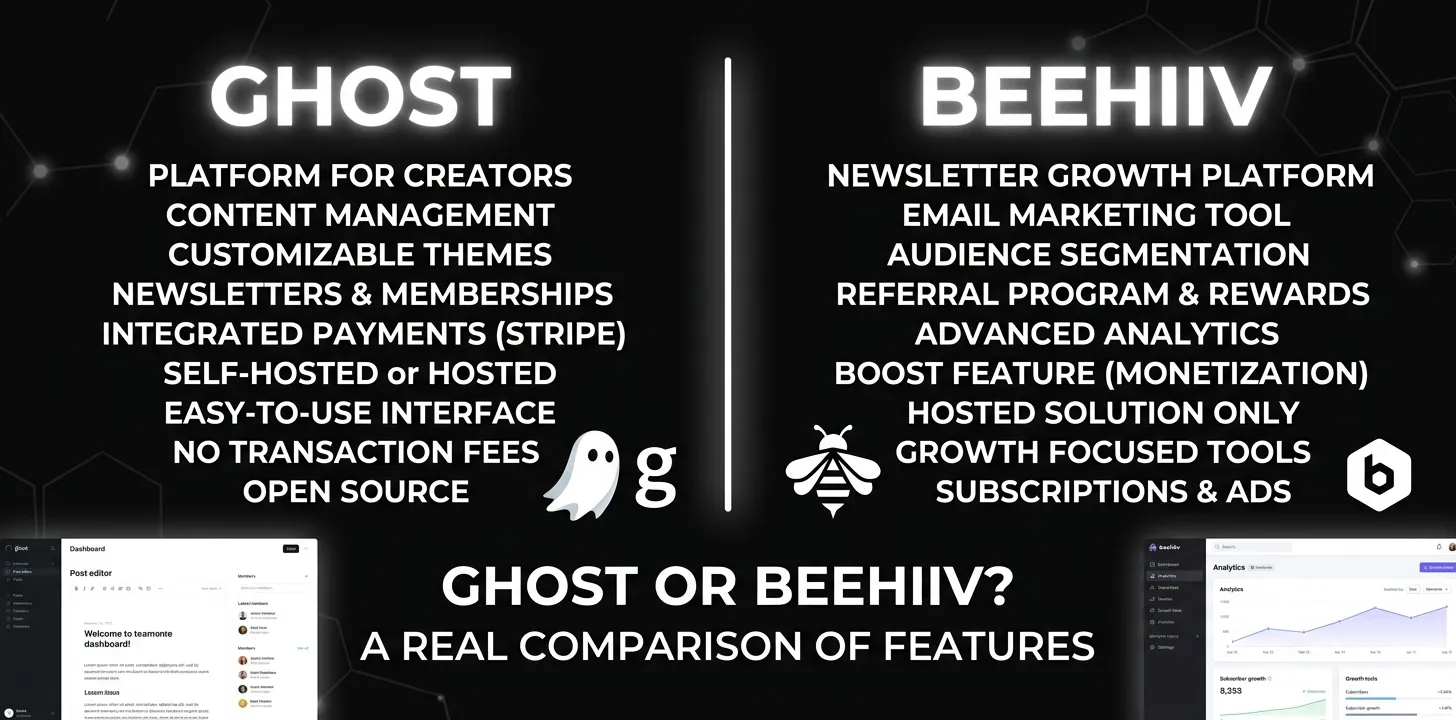
Ghost and beehiiv are both built for people who want to publish content and build an email audience, but they approach the job differently. Ghost is stronger as a full publishing website with memberships, SEO, and ownership-focused tools, while beehiiv is stronger for newsletter growth, audience acquisition, analytics, and monetization. The better choice depends on what you want your publication to become.
If you’re comparing Ghost or Beehiiv, the biggest mistake is looking only at the newsletter editor. Both platforms can publish articles, send emails, collect subscribers, and support paid content. The real differences appear in website control, audience-growth tools, monetization, analytics, customization, pricing, and how much you want your business centered around email.
Ghost vs Beehiiv at a Glance
| Feature | Ghost | beehiiv |
|---|---|---|
| Best for | Websites, publications, memberships | Newsletter growth and monetization |
| Website publishing | Excellent | Very good |
| Newsletter publishing | Excellent | Excellent |
| Free plan | No | Yes, up to 2,500 subscribers |
| Paid subscriptions | Yes | Yes |
| Platform fee on paid subscriptions | 0% | 0% |
| Built-in ad network | Limited compared with beehiiv | Yes |
| Referral tools | Yes | Yes |
| Recommendation network | Yes | Yes |
| SEO controls | Strong | Good |
| Website customization | Strong | Good |
| Newsletter growth tools | Good | Excellent |
| Email automations | More limited | Strong |
| A/B testing | More limited | Yes on paid plans |
| Digital products | Less central | Yes |
| Community features | Membership comments | Community feed, DMs and group chats on paid plans |
| Podcast support | Via integrations | Built in |
| Self-hosting option | Yes | No |
| Best overall for | Content-first brands | Newsletter-first businesses |
The important point is that neither platform is simply a “better newsletter tool.” They are designed around different publishing models.
What Is Ghost Best For?
Ghost is a publishing platform built around websites, articles, newsletters, memberships, and paid subscriptions.
It works especially well when your website is just as important as your email list.
You can publish an article on your site, send it as a newsletter, collect members, restrict content to paying members, and manage your publication from the same platform.
Ghost also gives publishers considerable control over branding and website structure. Its platform includes built-in SEO features, custom themes on higher plans, member tagging, multiple newsletters, analytics, and integrations.
That makes Ghost a strong fit for:
- Independent publishers
- Bloggers
- Online magazines
- Niche publications
- Writers building a membership business
- Companies using content marketing
- Creators who want their own website
- Publishers who want more control over their platform
Ghost is particularly attractive if you think of your business as a website with a newsletter, rather than a newsletter that happens to have a website.
What Is Beehiiv Best For?
beehiiv is designed more directly around newsletter growth, audience development, and monetization.
Its current platform combines newsletters, websites, analytics, recommendations, referral programs, paid subscriptions, digital products, advertising, automations, and other growth tools.
That makes it appealing to newsletter operators who want to grow quickly and eventually turn their audience into a business.
beehiiv is a strong fit for:
- Newsletter creators
- Media startups
- Solo newsletter operators
- Business newsletters
- Curated newsletters
- Publishers focused on subscriber growth
- Creators who want built-in monetization
- Teams running multiple publications
Its free Launch plan also gives new publishers a relatively easy way to get started, with up to 2,500 subscribers and unlimited email sends.
Website and Publishing Features
This is one of the biggest differences between Ghost and beehiiv.
Ghost gives you a more publication-focused website
Ghost treats the website as a core part of the product.
You can create posts, pages, navigation, membership areas, custom designs, and newsletters from the same publishing system. Ghost also provides built-in SEO features such as metadata, structured data, XML sitemaps, and canonical URLs.
On the Publisher plan and above, you can use custom themes or create your own design.
This gives Ghost an advantage if you want your publication to look and behave more like a traditional content website.
beehiiv also provides website hosting, custom domains, templates, subscribe forms, landing pages, and website analytics.
Its website builder has become much more capable, so it is no longer fair to think of beehiiv as only an email platform.
Still, the product’s strongest identity remains the newsletter.
If your main goal is:
Publish newsletter → acquire subscribers → grow audience → monetize audience
beehiiv’s feature set fits that workflow extremely well.
If your goal is:
Build website → publish content → rank in search → build members → send newsletters
Ghost has the more natural fit.
Both platforms handle the basic newsletter workflow well.
You can write content, format emails, manage subscribers, send newsletters, and track performance.
Ghost offers unlimited email sends on its current Ghost(Pro) plans and supports multiple newsletters on higher tiers. It also provides subscriber engagement and email analytics.
beehiiv likewise offers unlimited email sends across its plans and includes newsletter templates, segmentation, analytics, custom fields, and other publishing tools.
The difference becomes clearer when you look beyond simply sending emails.
beehiiv puts more emphasis on growth and experimentation. Depending on the plan, you can get A/B testing, automations, audience polls, advanced analytics, recommendations, referral programs, and other tools designed to improve subscriber acquisition and engagement.
For a creator who sends one thoughtful newsletter every week, both can work well.
For someone constantly testing headlines, acquisition channels, referrals, segments, and monetization strategies, beehiiv has the stronger toolkit.
Audience Growth
This is one area where beehiiv has a clear advantage.
Growing an email list is different from publishing an email. beehiiv has built several features specifically around acquisition.
These include:
- Recommendation Network
- Referral programs
- Recommendations
- Subscriber analytics
- Audience segmentation
- Signup and conversion tools
- Automations
- A/B testing on eligible plans
- Advertising opportunities
- Built-in monetization
Ghost also provides recommendations, referrals, an Explore network, member management, and SEO features.
However, Ghost’s approach is more closely connected to building a publication and membership ecosystem.
Which is better for growing from 0 to 10,000 subscribers?
beehiiv is generally the better fit if subscriber growth is your primary goal.
Its tools are more tightly centered around newsletter acquisition.
Ghost can certainly grow a large newsletter, but it makes more sense when the newsletter is part of a broader publication.
Monetization
Both platforms support paid subscriptions, but the monetization experience is different.
Ghost monetization
Ghost allows publishers to create paid memberships and subscription tiers. On eligible plans, you can offer different levels of access and charge recurring subscription fees.
Ghost does not add a platform transaction fee to paid subscriptions, although payment processor fees still apply.
This works well for businesses based around premium content.
For example, a publication could offer:
- Free articles
- Member-only articles
- A paid monthly membership
- A higher-priced annual membership
Ghost is particularly good when paid content is part of the publication itself.
beehiiv monetization
beehiiv goes further into newsletter monetization.
Its current platform includes:
- Paid subscriptions
- Ad Network
- Programmatic advertising
- Paid recommendations
- Sponsorship tools
- Digital products
- Group subscriptions
- Paid trials
- Subscription discounts
This gives newsletter operators more ways to earn money from the same audience.
For example, a business newsletter could make money through paid subscriptions while also accepting advertising and selling a digital product.
That broader monetization model is one of beehiiv’s strongest advantages.
Pricing: Ghost vs Beehiiv
Pricing can change, so it is worth checking the current plan before subscribing.
As of September 2026, beehiiv has a free Launch plan for up to 2,500 subscribers. Its Scale plan starts at $43 per month when billed annually, while Max starts at $96 per month.
Ghost(Pro) currently starts at $18 per month when billed annually for Starter. Publisher is $29 per month, while Business is $199 per month.
The important difference isn’t just the monthly price.
| Ghost | beehiiv | |
|---|---|---|
| Free plan | No | Yes |
| Entry-level annual price | $18/mo | $0 |
| Paid subscriptions | Available on eligible plans | Available on Scale and above |
| Email sends | Unlimited | Unlimited |
| Platform fee on paid subscriptions | 0% | 0% |
| Growth monetization | Moderate | Strong |
| Higher-end team features | Yes | Yes |
For someone starting with zero subscribers, beehiiv’s free plan makes the initial decision easier.
Ghost costs money from the beginning, but you are paying for a more complete publishing platform rather than simply an email service.
SEO and Organic Search
If Google traffic matters to your business, Ghost deserves serious consideration.
Ghost has built-in SEO features, including structured data, XML sitemaps, canonical URLs, and metadata controls. It is designed to function as a proper publishing website rather than only as an email archive.
beehiiv also supports websites, custom domains, SEO settings, and search-focused publishing.
However, there is an important strategic difference.
If your business model depends heavily on hundreds or thousands of evergreen articles bringing organic traffic, Ghost’s publishing model is generally more attractive.
If SEO is mainly a supporting channel for a newsletter business, beehiiv can be enough.
A practical example
Imagine you’re creating a newsletter about personal productivity.
If you plan to publish 300 search-focused articles such as productivity guides, app comparisons, and tutorials, while using email to bring readers back to the site, Ghost makes a lot of sense.
If you plan to send one newsletter every Tuesday, grow your subscriber list through referrals, and monetize the list with sponsorships, beehiiv is probably the better fit.
Analytics
Both platforms provide useful analytics, but they focus on different questions.
Ghost provides information around subscribers, email performance, engagement, signup attribution, and website activity. Higher plans add more advanced native analytics.
beehiiv puts a heavier emphasis on newsletter and growth analytics.
You can use analytics to understand subscriber behavior, campaign performance, acquisition, and audience growth. Higher plans also provide advanced website analytics and testing features.
If your question is:
“Which content is driving members and how is my publication performing?”
Ghost is a strong choice.
If your question is:
“Which acquisition channel is producing subscribers and how can I improve newsletter growth?”
beehiiv has the stronger orientation.
Customization and Branding
Ghost generally wins if you want deeper control over your publication’s appearance.
Ghost supports custom themes on higher plans, and its ecosystem includes many publication themes. Developers can also build custom experiences around Ghost’s APIs.
This makes it attractive for publishers who care about creating a distinct website rather than using a standard newsletter layout.
beehiiv offers website templates and customization tools, and its no-code approach makes it easier for nontechnical users to get a site running quickly.
So the trade-off is fairly simple:
Ghost: more publishing and design control.
beehiiv: easier newsletter-focused setup.
Automations and Email Marketing
This category leans toward beehiiv.
beehiiv’s paid plans include email automations, segmentation, custom fields, A/B testing, and other tools aimed at running more sophisticated newsletter campaigns.
That matters if you want sequences such as:
- Someone subscribes.
- They receive a welcome email.
- They receive a follow-up based on their activity.
- They are moved into a specific segment.
- They receive targeted content or an offer.
Ghost can support sophisticated workflows through its membership system and integrations, but email marketing automation is not as central to its product strategy.
If you are treating your publication like an email marketing operation, beehiiv has the advantage.
Integrations and Flexibility
Ghost is an open-source platform and offers APIs and integrations that can make it very flexible for developers.
That matters if you want to connect your publication with other services or build a custom front end.
beehiiv also provides API access and integrations with services such as analytics and automation platforms.
The difference is less about whether integrations exist and more about the type of flexibility you want.
Ghost is attractive for technical control and custom publishing experiences.
beehiiv is attractive for connecting newsletter growth and marketing workflows.
Paid Memberships: Which Handles Them Better?
Both can work well for paid newsletters.
Ghost is especially strong if you want paid membership to be deeply integrated with the website.
You can publish public content, restrict premium content, create membership tiers, and let members access their content through your publication.
beehiiv is strong if paid subscriptions are one part of a larger newsletter monetization strategy.
For example, you might combine:
- Paid subscriptions
- Sponsorships
- Ads
- Recommendations
- Digital products
That makes beehiiv more attractive for newsletter businesses with multiple revenue streams.
Podcasts and Digital Products
beehiiv has expanded beyond traditional newsletters.
Its current plans include podcast publishing and digital product tools, with more capabilities available on higher tiers.
That can be useful if you want to build several products around one audience.
Ghost can also support podcasts and other media through its publishing system and integrations, but these aren’t as central to the platform’s identity.
If your long-term plan is to build a newsletter plus digital products plus podcast business, beehiiv has a more obvious all-in-one growth model.
Ease of Use
Both platforms are relatively approachable, but they have different learning curves.
Ghost’s interface is clean and focused on publishing. The basics are easy to understand, but getting the most from themes, memberships, SEO, integrations, and customization may require more technical knowledge.
beehiiv is designed with newsletter operators in mind. Its growth and monetization features can make it easier to build a newsletter business without assembling several separate services.
For a beginner who only wants to start sending newsletters, either platform is manageable.
For a beginner who wants to grow and monetize a newsletter without dealing with much technical setup, beehiiv is usually the easier starting point.
Ghost vs Beehiiv: The Main Trade-Offs
Choose Ghost if you care more about the website
Ghost is the better choice when your publication needs:
- A strong content website
- SEO-focused publishing
- Custom themes
- Memberships
- Paid content
- Multiple newsletters
- Strong branding
- Developer flexibility
- Greater control over the publishing experience
beehiiv is the better choice when your priorities are:
- Growing an email list
- Referral programs
- Recommendations
- Newsletter analytics
- Email automations
- A/B testing
- Sponsorships
- Ad revenue
- Paid newsletters
- Digital products
- Starting with a free plan
For most people starting a newsletter from scratch, beehiiv has the easier entry point because you can begin for free and have access to core newsletter, website, analytics, and growth features.
The free plan supports up to 2,500 subscribers, which gives a new creator room to validate an idea before committing to a paid plan.
Ghost makes more sense if you’ve already decided that you want to build a serious publication website around your newsletter.
So the question isn’t simply:
“Which platform has more features?”
It’s:
“Where do I expect most of my business to happen?”
If the answer is in the inbox, lean toward beehiiv.
If the answer is on the website and inside a membership-based publication, lean toward Ghost.
Which One Is Better for SEO?
Ghost is the stronger choice for an SEO-heavy content business.
Its publishing system is built around websites and includes strong built-in SEO features.
That doesn’t mean beehiiv is bad for SEO. It can publish web content and support search-friendly websites.
But if your strategy is heavily dependent on building a large library of evergreen content that attracts organic traffic, Ghost’s website-first approach is a better match.
Which One Is Better for Making Money?
beehiiv has the edge if you want multiple newsletter revenue streams.
Its monetization system includes paid subscriptions, advertising, recommendations, sponsorship-related tools, and digital products.
Ghost is excellent for a business centered around memberships and premium content.
So:
- Paid membership publication: Ghost
- Advertising-driven newsletter: beehiiv
- Sponsorship-focused newsletter: beehiiv
- Premium content website: Ghost
- Newsletter + digital products: beehiiv
- Content site + membership: Ghost
Which One Should You Choose?
The answer depends on what you’re building.
| Your goal | Better choice |
|---|---|
| Start a free newsletter | beehiiv |
| Grow subscribers aggressively | beehiiv |
| Monetize with newsletter ads | beehiiv |
| Build a sponsorship-based newsletter | beehiiv |
| Sell digital products alongside a newsletter | beehiiv |
| Build an SEO-focused publication | Ghost |
| Build a membership website | Ghost |
| Publish lots of evergreen articles | Ghost |
| Create a highly branded publication website | Ghost |
| Build a paid content site | Ghost |
| Want self-hosting and deeper technical control | Ghost |
Frequently Asked Questions
beehiiv is generally better if newsletter growth and monetization are your main priorities. Ghost is better when the newsletter is part of a larger website, publishing, and membership business.
Does Ghost or beehiiv take a percentage of paid subscriptions?
Both currently advertise a 0% platform fee on paid subscriptions, although payment processors such as Stripe still charge their own processing fees. Plan availability and other platform features can differ between the two services.
Can you move from Ghost to beehiiv or vice versa?
Yes. Both platforms provide ways to import and export audience data, so switching is possible. However, moving a publication also involves transferring content, redirects, website design, integrations, and other parts of your publishing setup, so the process can be more involved than simply moving an email list.
Ghost or Beehiiv: The Bottom Line
Ghost and beehiiv overlap, but they are optimized for different businesses. Ghost is the better publishing platform, while beehiiv is the better newsletter-growth platform. If your website, SEO, branding, and memberships come first, choose Ghost. If subscriber growth, advertising, referrals, analytics, and newsletter monetization come first, choose beehiiv.
For a new newsletter creator who wants to test an idea with little upfront cost, I’d start with beehiiv. For someone building a long-term content publication where the website is a major asset, Ghost is the more compelling choice.
The best move is to decide your primary business model first, then choose the platform that supports that model instead of choosing based on the longest feature list.