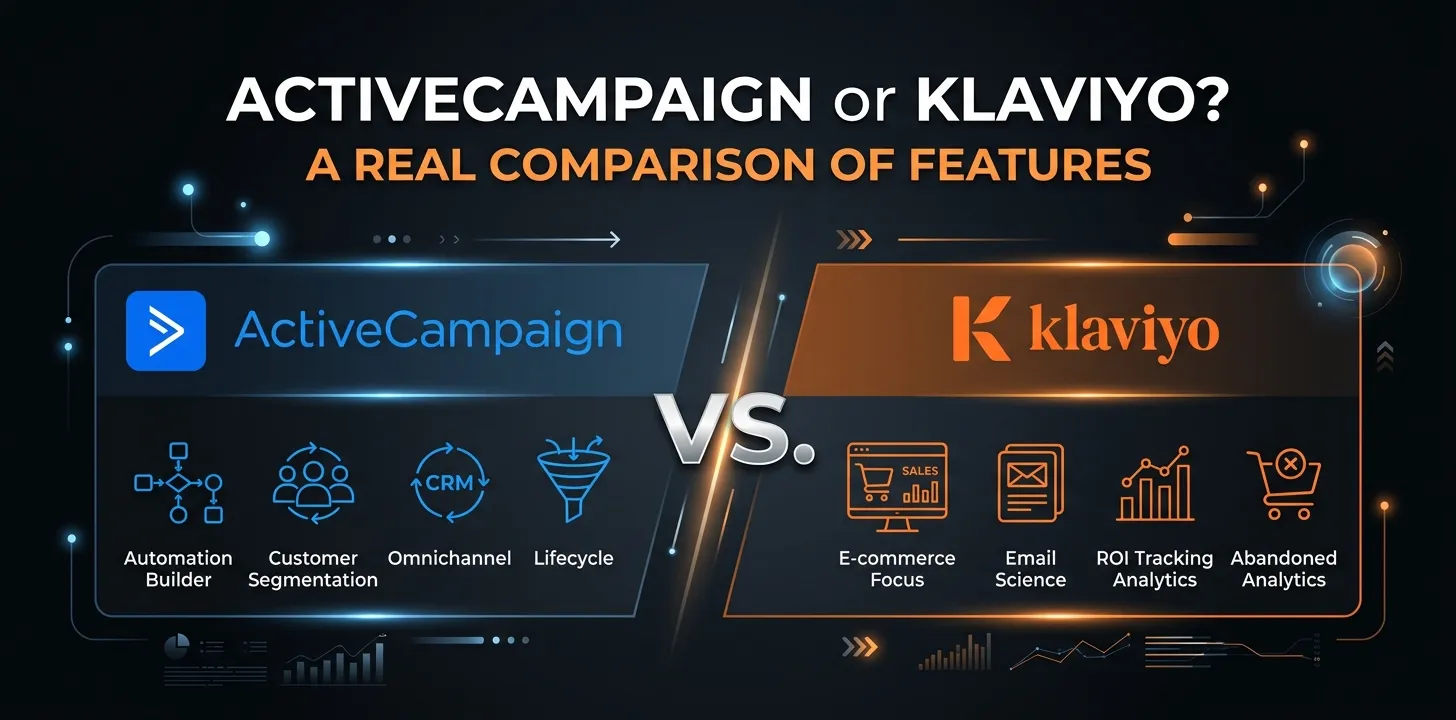
ActiveCampaign or Klaviyo? A real comparison of features

If you are choosing between ActiveCampaign and Klaviyo, the biggest difference is what each platform is built to do. Klaviyo is more focused on ecommerce customer marketing, while ActiveCampaign combines marketing automation with CRM, sales automation, and broader customer journeys. Both handle email, segmentation, automation, and SMS, but they approach those features differently.
The right choice depends less on which platform has more features and more on how your business collects customer data, sells products, manages leads, and builds automated journeys.
ActiveCampaign vs. Klaviyo at a Glance
| Feature | ActiveCampaign | Klaviyo |
|---|---|---|
| Main focus | Marketing automation, CRM, sales, lifecycle marketing | Ecommerce and B2C marketing |
| Email marketing | Excellent | Excellent |
| Marketing automation | Very advanced | Advanced |
| Ecommerce automation | Strong | Excellent |
| CRM | Built-in CRM and sales tools | B2C CRM/customer profiles |
| Sales pipelines | Yes | Not its traditional strength |
| Segmentation | Advanced | Excellent for ecommerce data |
| SMS | Available | Available |
| Mobile push | Limited compared with Klaviyo | Yes |
| AI tools | Extensive AI and automation features | Extensive AI and predictive tools |
| Ecommerce data | Strong | Core strength |
| Integrations | 1,000+ | 350+ |
| Landing pages | Available on qualifying plans | Not a core native feature |
| Best for | Businesses with complex customer journeys | Ecommerce and DTC brands |
ActiveCampaign currently lists more than 1,000 integrations, while Klaviyo highlights more than 350 integrations and APIs.
What Is the Main Difference Between ActiveCampaign and Klaviyo?
The simplest way to think about the two platforms is this:
ActiveCampaign is built around the entire customer lifecycle. Klaviyo is built around customer data, ecommerce marketing, and revenue-focused engagement.
ActiveCampaign can connect marketing activity with sales pipelines, lead scoring, CRM records, and broader automation. Its current platform includes marketing automation, CRM capabilities, landing pages, ecommerce integrations, segmentation, and cross-channel tools.
Klaviyo takes a more ecommerce-centered approach. Customer profiles, purchase history, browsing behavior, segmentation, predictive analytics, email, SMS, push notifications, and automated flows are tightly connected.
That difference becomes important when your business grows beyond simple email campaigns.
Email Marketing Features
Both platforms are strong choices for email marketing.
You can create newsletters, promotional campaigns, automated emails, personalized messages, and behavior-based campaigns with either platform.
ActiveCampaign offers a drag-and-drop email designer, HTML editing, conditional content, A/B testing, predictive sending, and more than 250 pre-built templates on its current platform.
Klaviyo focuses heavily on ecommerce email creation. Its current email platform includes more than 160 customizable templates, customer-profile data, personalized product recommendations, campaigns, forms, and automated flows.
Which is better for email?
For basic email marketing, the difference is small.
For a Shopify store or DTC brand, Klaviyo often feels more natural because ecommerce data is central to the platform.
For a company that needs email to work alongside sales pipelines, lead nurturing, and broader business automation, ActiveCampaign has the stronger overall setup.
Marketing Automation
This is one of the biggest areas where ActiveCampaign stands out.
ActiveCampaign supports multi-step automations with multiple triggers, branching logic, goals, A/B testing, CRM actions, ecommerce events, and cross-channel actions. Its current platform lists hundreds of automation recipes and unlimited automation actions on higher plans.
This makes it useful for complicated customer journeys.
For example, a software company could create a journey like:
- Someone downloads a guide.
- The contact enters a lead-nurture sequence.
- Their engagement changes their lead score.
- A sales representative receives a task.
- The contact moves into a CRM pipeline.
- A sales-stage change triggers another email.
- A purchase starts a customer onboarding sequence.
Klaviyo can also create sophisticated automated journeys. Its flows can react to events such as product views, checkout activity, purchases, form submissions, price drops, and customer engagement. Conditional and trigger splits can send people down different paths.
Which has better automation?
ActiveCampaign wins for overall automation flexibility.
Klaviyo wins for ecommerce automation simplicity.
If your main automation needs are abandoned carts, welcome sequences, post-purchase emails, product recommendations, win-back campaigns, and customer retention, Klaviyo gives you a very focused toolkit.
If you want marketing automation to interact with sales, CRM data, lead scoring, and longer customer journeys, ActiveCampaign is the stronger choice.
Ecommerce Features
Klaviyo has a clear advantage if ecommerce is the center of your business.
Its platform is designed around customer and shopping data. You can use browsing behavior, purchases, product information, customer activity, and predictive data for segmentation and personalization.
Common ecommerce automations include:
- Welcome series
- Abandoned cart reminders
- Browse abandonment
- Post-purchase follow-ups
- Back-in-stock alerts
- Price-drop messages
- Cross-sell campaigns
- Win-back campaigns
- Product recommendations
Klaviyo’s flow system supports email, SMS, and push notifications, allowing ecommerce brands to combine multiple channels in one customer journey.
ActiveCampaign is also capable of ecommerce marketing. It supports ecommerce integrations such as Shopify, WooCommerce, Square, BigCommerce, Magento, and Shopify Plus, depending on the plan and integration type.
The difference is that ecommerce is one part of ActiveCampaign, while it is much closer to the center of Klaviyo’s product strategy.
Example: Shopify store
Imagine you sell skincare products online.
With Klaviyo, you can create a segment of customers who:
- Viewed a specific product
- Did not purchase
- Have purchased before
- Have high predicted lifetime value
- Are subscribed to SMS
You can then send a targeted campaign or flow based on those conditions.
Klaviyo supports granular segmentation using customer attributes, browsing activity, purchases, predictive analytics, and data from connected systems.
ActiveCampaign can also handle this type of ecommerce personalization, but its broader CRM and automation capabilities become more valuable when the business has other customer journeys outside the store.
CRM and Sales Features
This is where ActiveCampaign becomes much more attractive.
ActiveCampaign combines marketing automation with CRM and sales functionality. Depending on the plan and add-ons, its CRM capabilities include pipelines, deal records, lead scoring, sales engagement, and sales automation.
That makes it useful for businesses where a customer does not simply click an email and buy.
Consider a consulting company.
A potential customer might:
- Download a report
- Attend a webinar
- Receive several nurture emails
- Request a consultation
- Become a sales opportunity
- Move through several pipeline stages
- Receive personal follow-ups
- Eventually become a client
ActiveCampaign can connect these marketing and sales activities in one system.
Klaviyo has expanded beyond traditional ecommerce email and now positions itself as a B2C CRM with unified customer profiles, service data, segmentation, predictive analytics, and omnichannel marketing.
However, if you specifically need traditional sales-pipeline management and lead-oriented automation, ActiveCampaign remains the more natural fit.
Segmentation and Personalization
Both platforms offer strong segmentation, but their strengths are slightly different.
ActiveCampaign can segment contacts using information such as contact fields, tags, site activity, ecommerce behavior, and CRM information. Higher-tier plans add more advanced segmentation and personalization capabilities.
Klaviyo is especially strong when segmentation depends on ecommerce behavior.
For example, you could create an audience based on:
Customers who bought from a certain product category, used a discount code, live in a particular location, and have a specific predicted customer value.
Klaviyo supports segmentation using demographic information, browsing behavior, purchase history, product data, location, custom properties, predictive analytics, and other connected data. Its segments can also update in real time.
Which has better segmentation?
For ecommerce segmentation, Klaviyo has the edge.
For CRM + marketing segmentation, ActiveCampaign is more versatile.
The distinction matters because an ecommerce marketer thinks about customers differently from a sales team.
AI Features
AI is now a major part of both platforms.
ActiveCampaign’s current platform includes AI-powered automation building, AI campaign creation, AI-suggested segments, AI content generation, AI image generation, predictive sending, and other Active Intelligence features.
Klaviyo also has a strong AI layer. Its tools include AI-assisted segmentation and flow creation, predictive analytics, personalized recommendations, and Composer, which can generate campaigns and flows from natural-language instructions.
For example, instead of manually building a customer segment, you can describe the audience you want and let the platform help construct it.
Which has better AI?
There isn’t a simple winner.
ActiveCampaign has an advantage when AI is used inside broader marketing and automation workflows.
Klaviyo has an advantage when AI is applied to ecommerce customer data, segmentation, predictions, and personalized shopping experiences.
AI should not be the deciding factor by itself. The underlying data and automation model matter more.
SMS and Multichannel Marketing
Both platforms extend beyond email.
ActiveCampaign supports email plus additional channels such as SMS and WhatsApp, with features varying by plan and add-on. Its platform also supports cross-channel automation.
Klaviyo supports email, SMS, mobile push, and WhatsApp, with cross-channel flows that can use customer behavior to determine what happens next.
For an ecommerce brand, this can be useful for situations such as:
Email: “Your cart is waiting.”
SMS: A short reminder several hours later.
Push notification: A personalized product or promotion message.
The goal is not simply to use more channels. It is to use the right channel for the customer and the situation.
Forms and Lead Capture
Both platforms provide tools for growing an audience.
ActiveCampaign offers forms that can capture leads and immediately trigger automations. Its platform also includes landing pages on qualifying plans.
Klaviyo provides pop-ups, flyouts, embedded forms, full-page forms, and multi-step forms. Its forms can be connected directly to segmentation and automated customer journeys.
For ecommerce stores, Klaviyo’s form and customer-data system makes sense because the captured subscriber can quickly become part of an ecommerce-focused lifecycle.
For businesses using landing pages as part of lead generation and sales funnels, ActiveCampaign offers a broader set of tools.
Integrations
Integration support can become a major issue as your marketing stack grows.
ActiveCampaign currently advertises more than 1,000 integrations, including ecommerce platforms, CRM systems, advertising tools, calendars, payment services, productivity tools, and other business software.
Klaviyo currently highlights more than 350 integrations and APIs, with a strong focus on connecting ecommerce, customer, marketing, and service data.
More integrations do not automatically make one platform better.
The important question is:
Does it integrate with the tools your business actually uses?
A Shopify store may care most about ecommerce, reviews, subscriptions, customer service, and advertising integrations. A B2B company may care more about Salesforce, sales tools, calendars, CRM systems, and lead-management platforms.
Reporting and Analytics
Klaviyo’s reporting is heavily focused on customer engagement and ecommerce performance.
Its platform provides reporting across email, SMS, and mobile push, along with revenue attribution, customer segmentation, product analysis, RFM analysis, benchmarks, and predictive analytics.
This is particularly useful when the main question is:
Which marketing activity is generating revenue from our customers?
ActiveCampaign takes a broader approach. Its platform combines marketing, automation, CRM, sales, ecommerce, attribution, and conversion tracking features.
That can be more useful when marketing and sales data need to be viewed together.
Ease of Use
Klaviyo generally has an advantage for teams that want to get an ecommerce marketing system running quickly.
Its flow templates cover common ecommerce scenarios, and the visual builder is designed around customer actions such as purchases, product views, checkout activity, and engagement.
ActiveCampaign can take more time to understand because there is simply more flexibility.
That flexibility is useful, but it can also create more decisions.
A small online store may look at ActiveCampaign and think, “Why do I need all of this?”
A growing company with complicated customer journeys may have the opposite reaction:
“Finally, I can build the workflow I actually need.”
So ease of use depends partly on how complicated your marketing strategy is.
Pricing and Overall Value
Pricing changes based on contact count, plan, channels, and optional features, so comparing only the starting monthly price can be misleading.
Klaviyo currently offers a free plan with limits, including up to 250 profiles and 500 email sends per month, along with limited mobile messaging and other features.
ActiveCampaign uses tiered plans with different levels of automation, segmentation, AI, CRM, ecommerce, and other capabilities. Some features are also available through add-ons.
When comparing cost, look at the total system you need, not just the subscription price.
For example, if ActiveCampaign lets you replace separate automation, CRM, and landing-page tools, its higher subscription cost may still represent better value.
On the other hand, if you mainly need ecommerce email and SMS, paying for capabilities you rarely use may not make sense.
ActiveCampaign vs. Klaviyo: Which One Should You Choose?
Choose Klaviyo if:
- Your business is primarily ecommerce or DTC.
- Shopify or another ecommerce platform is central to your marketing.
- You want deep purchase and browsing-based segmentation.
- Your main goal is increasing ecommerce revenue and customer retention.
- You need strong email, SMS, and push automation.
- You want to build common ecommerce flows quickly.
- Predictive ecommerce analytics are important to your strategy.
Choose ActiveCampaign if:
- You need marketing automation and CRM in the same ecosystem.
- Your business has a sales team.
- You manage leads through sales pipelines.
- Customer journeys extend beyond ecommerce purchases.
- You need complex branching automations.
- You operate across ecommerce, services, B2B, or multiple business models.
- You need a large integration ecosystem.
- You want marketing activity to trigger sales actions and vice versa.
ActiveCampaign vs. Klaviyo for Different Types of Businesses
| Business type | Better fit | Why |
|---|---|---|
| Shopify store | Klaviyo | Strong ecommerce data and customer journeys |
| DTC brand | Klaviyo | Excellent retention and revenue-focused marketing |
| Small online retailer | Klaviyo | Easier ecommerce-focused setup |
| B2B company | ActiveCampaign | Stronger CRM and sales automation |
| Consulting business | ActiveCampaign | Lead nurturing and pipeline management |
| SaaS company | ActiveCampaign | Flexible lifecycle and lead automation |
| Ecommerce + sales team | ActiveCampaign | Connects ecommerce marketing with CRM |
| Complex customer journey | ActiveCampaign | Deeper automation flexibility |
| Customer-retention-focused ecommerce | Klaviyo | Strong behavioral and predictive segmentation |
| Business using many different tools | ActiveCampaign | Larger integration ecosystem |
A Practical Example: When Klaviyo Makes More Sense
Imagine a small U.S. clothing brand with a Shopify store.
The company wants to:
- Collect email subscribers
- Send welcome emails
- Recover abandoned carts
- Recommend products
- Send post-purchase messages
- Identify VIP customers
- Send SMS promotions
- Win back inactive buyers
There is no sales team and no complicated B2B sales process.
Klaviyo would probably be the better fit.
The business can focus on customer behavior, products, purchases, engagement, and retention without needing a more extensive CRM-centered system.
A Practical Example: When ActiveCampaign Makes More Sense
Now consider a consulting company that sells high-value services.
A prospect might download a free guide, attend a webinar, request a consultation, speak with a salesperson, and go through several sales stages before becoming a customer.
The company wants marketing activity to influence lead scoring and sales follow-up.
ActiveCampaign would probably make more sense.
The value here is not simply sending better emails. It is connecting marketing automation with the sales process.
What About Using Both?
Most businesses do not need both platforms.
Running two marketing automation systems can create unnecessary complexity, duplicated customer data, extra costs, and more maintenance.
If your needs are clearly ecommerce-focused, starting with Klaviyo is usually easier to justify.
If your needs involve CRM, sales, lead nurturing, and complex automation, ActiveCampaign is likely the better long-term foundation.
The exception is when a company has a very specific reason to maintain separate systems. In that situation, the integration and data-sync requirements should be evaluated before choosing a setup.
Common Questions About ActiveCampaign and Klaviyo
Is ActiveCampaign better than Klaviyo for ecommerce?
Not automatically. Klaviyo is highly focused on ecommerce customer data, product behavior, retention, and revenue-focused marketing, while ActiveCampaign is better suited when ecommerce marketing also needs to connect with CRM, sales, and broader customer journeys.
Which is easier to use, ActiveCampaign or Klaviyo?
Klaviyo can be easier to learn for a typical ecommerce marketing workflow because its tools and templates are built around common online-store use cases. ActiveCampaign can take longer to master because its automation and CRM capabilities support more complex workflows.
Should I choose Klaviyo or ActiveCampaign for a small business?
Choose based on how the business sells. A small ecommerce store will often get more value from Klaviyo’s ecommerce-focused marketing tools, while a service business or company with lead nurturing and sales pipelines may benefit more from ActiveCampaign’s broader automation and CRM capabilities.
Final Verdict
There is no universal winner between ActiveCampaign and Klaviyo.
Klaviyo is the stronger choice for ecommerce-first businesses that want powerful customer segmentation, personalized campaigns, and revenue-focused email, SMS, and push marketing.
ActiveCampaign is the stronger choice when marketing automation needs to connect with CRM, sales, lead nurturing, and complex customer journeys.
A simple rule can help: if the store is the center of your business, start with Klaviyo. If the customer lifecycle and sales process are the center of your business, start with ActiveCampaign.
Before subscribing, map out your three most important automations and the customer data they need. The platform that handles those workflows cleanly without forcing extra tools is usually the better choice.