Brevo or Omnisend? Find out which is the best

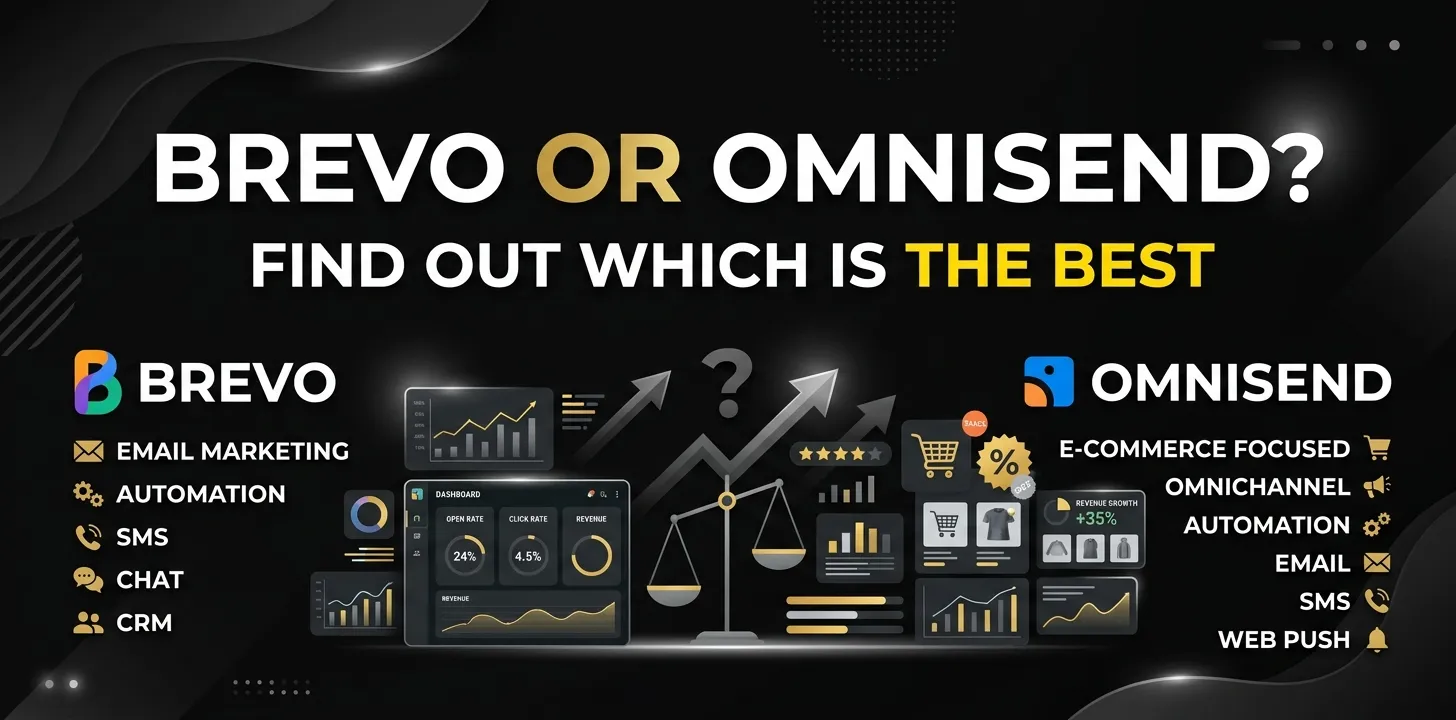
Brevo and Omnisend are both strong email marketing platforms, but they are built for different priorities. Brevo is the better all-around choice for small businesses that want email, CRM, sales, SMS, and transactional messaging in one platform. Omnisend is the better choice for ecommerce stores that need product-focused automation, segmentation, and email/SMS marketing tied closely to shopping behavior.
If you’re choosing between Brevo and Omnisend, the right option depends less on which platform has more features and more on what you’re trying to accomplish with your marketing.
A local service business, consultant, B2B company, or growing startup may have very different needs from a Shopify store sending abandoned-cart and post-purchase campaigns.
Let’s compare them based on the things that matter most.
Brevo vs. Omnisend at a glance
| Category | Brevo | Omnisend |
|---|---|---|
| Best for | Small businesses and broader marketing needs | Ecommerce businesses |
| Email marketing | Excellent | Excellent |
| Ecommerce marketing | Good | Excellent |
| Marketing automation | Strong | Excellent |
| SMS marketing | Yes | Yes, with current plan limitations |
| CRM and sales tools | Strong | More ecommerce-focused |
| Transactional email | Yes | Less focused |
| Product-focused campaigns | Good | Excellent |
| Push notifications | Yes | Yes |
| Segmentation | Strong | Strong, especially for ecommerce |
| Free plan | Yes | Yes |
| Starting paid price | $9/month | $16/month |
| Best overall for ecommerce | Good | Better |
| Best general-purpose platform | Better | Good |
Brevo’s current plans start with a free tier, followed by Starter from $9/month and Standard from $18/month. Omnisend’s current Free plan supports up to 500 emails per month to 250 contacts, while Standard starts at $16/month and Pro at $59/month.
The biggest difference between Brevo and Omnisend
The simplest way to understand the difference is this:
Brevo is a broader customer communication and marketing platform. Omnisend is much more focused on ecommerce marketing.
Brevo combines email marketing with CRM, sales features, transactional messaging, SMS, WhatsApp, forms, landing pages, and automation.
Omnisend, on the other hand, puts ecommerce at the center. Its features include product listings, discount codes, product recommendations, purchase-based segmentation, ecommerce automation, and email, SMS, and push campaigns.
That difference should drive your decision.
If you sell products online, Omnisend deserves serious consideration.
If you need a broader business communication platform, Brevo may make more sense.
Brevo: Where it makes the most sense
Brevo works well when email marketing is only one part of your customer communication strategy.
You can use it for marketing campaigns, automation, transactional messages, CRM, sales pipelines, forms, and multiple messaging channels.
That makes Brevo especially useful for businesses such as:
- Service businesses
- Consultants
- Agencies
- B2B companies
- Startups
- Small online businesses
- Newsletter publishers
- Businesses that need transactional email
- Companies that want basic CRM and sales tools alongside marketing
For example, imagine a small web design agency.
It may need a form to collect leads, an automated welcome email, follow-up messages, a sales pipeline, appointment scheduling, and transactional emails.
It doesn’t necessarily need a sophisticated ecommerce product recommendation system.
Brevo can cover more of those needs in one ecosystem.
Brevo’s automation capabilities
Brevo’s automation system lets you create workflows based on triggers, rules, and actions. Examples include welcome sequences, abandoned-cart reminders, birthday messages, and follow-ups based on website activity.
For ecommerce users, Brevo can also connect store data and track activities such as product views, cart updates, and completed purchases.
So Brevo isn’t a weak ecommerce tool.
It simply isn’t as narrowly centered around ecommerce as Omnisend.
Omnisend: Where it stands out
Omnisend is designed around the needs of online stores.
Its platform connects email marketing with ecommerce data so businesses can build campaigns and automations around shopping behavior. Features include product blocks, product recommendations, discount codes, segmentation, conversion tracking, and behavior-based automation.
That makes it a strong fit for:
- Shopify stores
- WooCommerce stores
- Direct-to-consumer brands
- Fashion stores
- Beauty stores
- Home goods stores
- Subscription products
- Stores with frequent promotions
- Businesses that rely heavily on abandoned-cart recovery
Omnisend’s automation system supports pre-built workflows, multi-step logic, audience filters, conditional splits, event-based triggers, A/B testing, product recommendations, and channel branching.
For an ecommerce marketer, those capabilities can be more useful than having a broad CRM system.
Email marketing: Brevo vs. Omnisend
Both platforms can handle the basics well.
You can create newsletters, promotional campaigns, automated messages, segments, and personalized emails.
The difference appears when you look at why you’re sending those emails.
Brevo is flexible enough for many types of businesses. You can use it for newsletters, lead nurturing, customer communication, transactional emails, and general marketing automation.
Omnisend is especially strong when emails need to be connected to products and shopping activity.
For example, an online clothing store might want to send:
- A welcome email
- A product recommendation
- An abandoned-cart reminder
- A discount email
- A post-purchase message
- A cross-sell campaign
- A win-back campaign
That’s exactly the type of marketing workflow Omnisend is designed to support.
Winner for general email marketing: Brevo
Winner for ecommerce email marketing: Omnisend
Marketing automation
Automation is important because it determines how much of your marketing can run without manual work.
Both platforms provide workflow automation, but their strengths differ.
Brevo lets you build automated workflows around contact activity and marketing events. Ecommerce users can also trigger workflows from shopping actions such as cart updates.
Omnisend goes deeper into ecommerce-specific automation. Its automation tools include product recommendations, behavioral triggers, conditional splits, lifecycle stages, A/B testing, and revenue attribution.
If your main automation question is:
“How do I nurture leads and communicate with customers?”
Brevo is a strong choice.
If your question is:
“How do I automatically turn store behavior into more sales?”
Omnisend has the advantage.
Winner: Omnisend for ecommerce automation
Ecommerce features
This is where the comparison becomes much clearer.
Omnisend was built specifically around ecommerce marketing. Its feature set includes product listing blocks, discount codes, product recommendations, conversion tracking, real-time store synchronization, and behavior-based triggers.
Brevo can also handle ecommerce marketing.
For example, its WooCommerce integration can sync customers, orders, and products, track customer behavior, recover abandoned carts, and use purchase data for segmentation.
Brevo also supports product feeds and personalized product recommendations when an appropriate ecommerce connection is configured.
But if ecommerce is the main reason you’re buying an email marketing platform, Omnisend’s product-focused approach makes the decision easier.
Winner: Omnisend
CRM and sales tools
This is one area where Brevo has a meaningful advantage.
Brevo isn’t only an email marketing platform. It also includes CRM and sales functionality, including contact management, deals, pipelines, meeting scheduling, tasks, and sales reporting.
That’s useful when your business has a sales process beyond an online checkout.
For example, a marketing agency might collect a lead today, schedule a sales call tomorrow, send follow-up emails, move the lead through a pipeline, and eventually close a deal.
Omnisend is much more focused on marketing to ecommerce shoppers and customers.
Winner: Brevo
SMS and multichannel marketing
Both platforms support more than email, but their approach is slightly different.
Brevo supports email, SMS, WhatsApp, transactional messaging, and other communication channels depending on the plan and product.
Omnisend combines email, SMS, and push notifications around ecommerce campaigns and automation.
One important pricing change matters here: for Omnisend customers subscribing to paid plans on or after May 4, 2026, SMS is available through the Pro plan as a separate volume-based SMS option; Standard does not include SMS under the current rules.
So don’t compare the platforms based only on the word “SMS.” Check the exact plan you would need.
Winner for broader multichannel communication: Brevo
Winner for ecommerce-focused multichannel campaigns: Omnisend
Segmentation
Segmentation lets you send different messages to different groups instead of treating your entire contact list the same.
Brevo supports segments based on factors such as location, language, behavior, and contact data.
Omnisend can segment customers based on behavior, purchase history, engagement, and other ecommerce information.
Consider two businesses.
A consulting company may want segments such as:
- Prospects
- Existing clients
- Past clients
- Leads from different locations
- People who downloaded a guide
Brevo fits that situation well.
An online store may want:
- Customers who bought shoes
- Customers who haven’t purchased in 90 days
- High-value customers
- Shoppers who abandoned carts
- People who viewed a particular product
Omnisend’s ecommerce focus becomes more useful in that situation.
Winner: Tie, depending on the business
Pricing: Brevo vs. Omnisend
Pricing deserves careful attention because the cheapest starting price isn’t necessarily the cheapest platform for your specific list size and sending needs.
Brevo currently offers a Free plan, Starter from $9/month, and Standard from $18/month. Its pricing is largely structured around monthly email volume and contact storage.
Omnisend currently offers a Free plan, Standard from $16/month, and Pro from $59/month. Its paid pricing is based on billable contacts, with Standard email credits tied to the number of billable contacts and Pro offering unlimited emails.
| Pricing factor | Brevo | Omnisend |
|---|---|---|
| Free option | Yes | Yes |
| Entry paid plan | From $9/month | From $16/month |
| Pricing focus | Email volume + contacts | Billable contacts + plan |
| Ecommerce features | Available | Core focus |
| CRM/sales features | Yes | More limited |
| Unlimited automation | Standard and above | Available within Omnisend’s automation system, subject to plan limits |
| SMS | Available | Current paid-plan rules vary |
| Best pricing fit | Businesses with varied marketing needs | Ecommerce stores |
There is an important difference in how the two companies count contacts.
Omnisend’s paid plans currently calculate billing using billable contacts, which can include subscribers and non-subscribers. This means your bill can rise even when your traditional subscriber count doesn’t change.
So if you’re comparing prices, don’t just look at the advertised starting price.
Use your actual contact count, email volume, automation needs, and SMS requirements.
Which is easier to use?
Both platforms are designed for marketers rather than developers.
Brevo can feel broader because you’re working with multiple products, including marketing, CRM, sales, transactional messaging, and automation.
That breadth is useful, but it can also mean there are more areas to learn.
Omnisend has a narrower purpose, which can make its interface and feature set feel more natural for an ecommerce marketer.
If you’ve already used Shopify or WooCommerce and mainly want to build ecommerce campaigns, Omnisend’s focus can be an advantage.
Winner for ecommerce simplicity: Omnisend
Winner for broader business flexibility: Brevo
Brevo vs. Omnisend for Shopify
If you run a Shopify store, both can work.
Brevo supports Shopify and can connect store data with marketing functions. Its ecosystem also supports tracking and ecommerce automation.
Omnisend is particularly focused on ecommerce platforms and offers Shopify-specific marketing capabilities around products, customer behavior, campaigns, and automation.
For a Shopify store that mainly wants email and SMS revenue campaigns, Omnisend is usually the more natural fit.
For a Shopify business that also wants broader CRM, sales, transactional messaging, and general customer communication, Brevo becomes more attractive.
Brevo vs. Omnisend for WooCommerce
WooCommerce users also have a good reason to consider Brevo.
Brevo’s WooCommerce integration can synchronize customers, orders, and products and track actions such as product views, cart updates, and purchases. It can then use that information for segmentation and automation.
Omnisend also supports ecommerce-focused workflows and integrations.
The deciding factor is therefore less about whether either platform can work with WooCommerce and more about what you want to do after the integration.
If you want advanced ecommerce marketing workflows, lean toward Omnisend.
If you want ecommerce marketing plus CRM, transactional communication, and broader business tools, Brevo may be the better fit.
Which one should a small business choose?
For a typical small business that isn’t primarily an online store, I’d lean toward Brevo.
A service company doesn’t necessarily need advanced product recommendations or purchase-based ecommerce workflows.
It may get more value from having email marketing, CRM, sales tools, forms, transactional messages, and automation in the same platform.
For example, a local home-services company could use Brevo to collect leads, follow up automatically, schedule meetings, manage deals, and keep customers informed.
In that situation, Omnisend’s ecommerce specialization may not provide enough additional value to justify choosing it.
Which one should an ecommerce store choose?
For most ecommerce-focused use cases, I’d choose Omnisend.
The reason isn’t simply that it has more features.
It’s that many of its important features are built around the actual problems ecommerce marketers face: abandoned carts, product discovery, customer segmentation, post-purchase communication, promotions, and automated revenue-generating workflows.
If your marketing revolves around an online catalog and customer purchases, that focus matters.
If your main goal is sending newsletters, company updates, educational content, or lead-nurturing emails, Brevo is probably the better fit.
You don’t need an ecommerce-heavy platform just to send a weekly newsletter.
Brevo’s broader marketing and contact-management features make it a sensible option for businesses where products and online orders aren’t the center of the marketing strategy.
Which is better for abandoned carts?
Omnisend gets the edge.
Brevo can handle abandoned-cart automation when ecommerce tracking and the appropriate integration are configured.
But abandoned-cart recovery is one of the core ecommerce use cases around which Omnisend’s automation system is designed.
If recovering lost shopping carts is a major part of your marketing strategy, Omnisend is the more natural choice.
Which is better for transactional emails?
Brevo has the advantage.
Brevo provides a dedicated transactional messaging product for things such as order confirmations, password resets, and shipping notifications.
That makes it useful when you need both marketing emails and operational messages from the same broader platform.
For a business that depends heavily on transactional email, this can be an important factor that gets overlooked when comparing marketing platforms.
Two practical examples
Example 1: A small consulting business
Suppose you run a consulting company with 2,000 contacts.
You want to:
- Capture leads through forms
- Send a welcome sequence
- Schedule meetings
- Manage prospects
- Send newsletters
- Follow up with leads
- Track sales opportunities
You don’t sell products through an online store.
Brevo would be the better choice.
Its CRM and sales capabilities are much more relevant to this type of business than ecommerce-specific product automation.
Example 2: A Shopify clothing store
Now imagine a Shopify clothing store.
You want to:
- Recover abandoned carts
- Recommend products
- Segment shoppers by purchase behavior
- Send promotional campaigns
- Run post-purchase automation
- Combine email with other channels
Omnisend would be the stronger choice.
Its platform is designed around these ecommerce workflows and includes product-focused campaign and automation features.
Brevo or Omnisend: Which is better overall?
There isn’t one universal winner.
Choose Brevo if you want:
- A broader marketing platform
- CRM and sales tools
- Transactional messaging
- Email marketing for a non-ecommerce business
- Multiple communication channels
- Flexible marketing automation
- A lower starting paid price
Choose Omnisend if you want:
- Ecommerce-first marketing
- Strong product-focused campaigns
- Advanced ecommerce automation
- Purchase-based segmentation
- Abandoned-cart workflows
- Product recommendations
- Email, SMS, and push campaigns centered around your store
The biggest mistake would be choosing based only on price.
A $9 plan isn’t necessarily a better deal than a $16 plan if the more expensive platform gives your store the ecommerce features you actually need.
Frequently Asked Questions
Is Brevo better than Omnisend?
Brevo is better for businesses that need broader marketing, CRM, sales, and transactional communication. Omnisend is generally the stronger choice for ecommerce businesses that want product-focused automation and customer marketing.
Is Omnisend cheaper than Brevo?
Not necessarily. Brevo’s paid plans currently start lower, while Omnisend’s Standard plan starts at $16/month. However, the platforms use different pricing structures, so your actual cost depends on contacts, email volume, and the features you need.
Can Brevo and Omnisend both be used for Shopify?
Yes. Both platforms can connect with Shopify, but Omnisend is more tightly focused on ecommerce marketing. Brevo may be more attractive if your Shopify business also needs broader CRM, sales, and transactional communication features.
Final verdict
Brevo is the better all-around platform, while Omnisend is the better ecommerce marketing platform.
If you’re running a service business, agency, B2B company, newsletter, or general small business, start with Brevo.
If you’re running a Shopify or WooCommerce store and your main goal is to turn customer behavior into more purchases, Omnisend is the stronger pick.
The practical tip is simple: choose the platform based on your main marketing workflow, not the longest feature list. If your business revolves around contacts and sales conversations, Brevo makes more sense. If it revolves around products and purchases, Omnisend is likely the better fit.