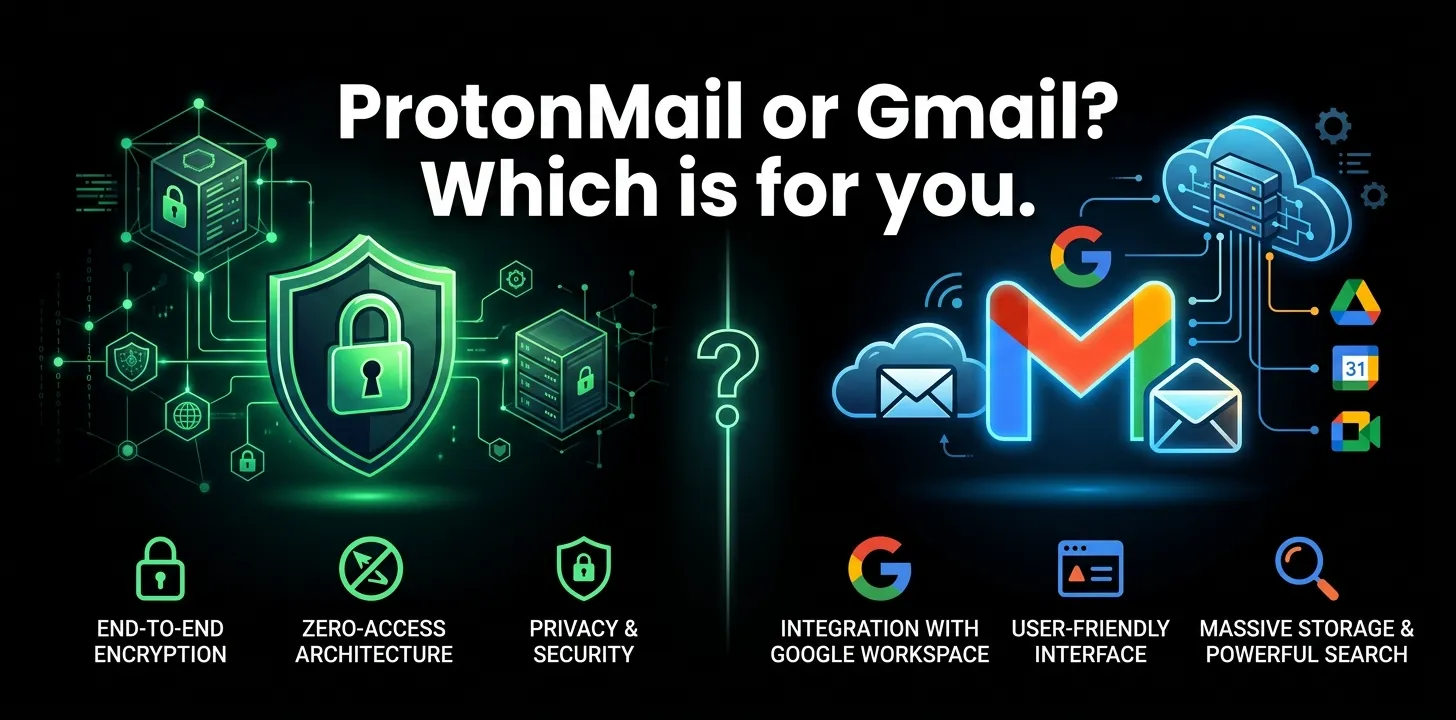
ProtonMail or Gmail? Which is for you

Choosing between Proton Mail and Gmail is less about finding one universal winner and more about deciding what matters most to you. Gmail is a strong choice for people who want Google integration, generous free storage, powerful search, and familiar productivity tools. Proton Mail is a better fit if privacy, encrypted email, and minimizing data collection are your top priorities.
Proton Mail vs. Gmail at a Glance
Both Proton Mail and Gmail are capable email services, but they are built around different priorities. Gmail focuses heavily on convenience and integration with Google’s wider ecosystem, while Proton Mail puts privacy and encryption at the center of its service.
| Feature | Proton Mail | Gmail |
|---|---|---|
| Free plan | Yes | Yes |
| Free storage | Up to 1 GB after completing Proton’s starter checklist | 15 GB shared across Google services |
| Privacy focus | Very strong | Strong account security, but less privacy-focused |
| Encryption | Zero-access encryption and end-to-end encryption in supported situations | Encryption in transit and at rest |
| Google integration | Limited compared with Gmail | Excellent |
| Search and organization | Strong | Excellent |
| Ads in inbox | No | Yes |
| Custom domains | Available on paid plans | Available through Google Workspace |
| Best for | Privacy-conscious users | Convenience, productivity, and Google users |
Proton Mail or Gmail: Which Is Better?
For most people, Gmail is the easier all-around choice, especially if you already use Google Drive, Google Calendar, Google Photos, Android, or other Google services.
Proton Mail is the better choice if email privacy is your main concern. Its architecture is designed around privacy-focused encryption and limiting the provider’s ability to access stored mailbox content.
The decision becomes much easier when you look at the areas that matter most.
Choose Gmail if You Want Convenience
Gmail makes sense if your email account is part of a larger Google workflow.
You may prefer Gmail if you regularly use:
- Google Drive
- Google Calendar
- Google Photos
- Google Meet
- Google Docs
- Android
- Google Workspace
- Other Google services
Gmail’s biggest advantage is not simply email. It is how naturally email fits into the rest of Google’s ecosystem.
For example, imagine you receive an email containing a document, need to save it to Drive, schedule a meeting, and then collaborate on the file in Google Docs. Gmail fits naturally into that workflow.
If you already live inside Google’s ecosystem, switching email providers can add unnecessary friction.
Choose Proton Mail if Privacy Comes First
Proton Mail is aimed at people who want stronger privacy protections around their email.
You may prefer Proton Mail if you are particularly concerned about:
- Email privacy
- Data exposure
- Tracking
- Sensitive personal communications
- Reducing dependence on large technology ecosystems
- Keeping stored messages encrypted
Proton uses zero-access encryption for stored mail, meaning Proton says it cannot access the contents of encrypted messages stored in your mailbox.
That makes Proton Mail attractive if your main question is:
“Can my email provider access the contents of my stored email?”
If privacy is less important than convenience and integration, Gmail’s approach may be perfectly acceptable for your needs.
Privacy: Proton Mail Has the Clear Advantage
Privacy is probably the biggest difference between Proton Mail and Gmail.
Proton has designed its email service around encrypted storage and privacy. Gmail, meanwhile, is part of Google’s much larger ecosystem of personalized services and data processing.
The important distinction is that encryption does not automatically mean the same thing as end-to-end or zero-access encryption.
With Proton Mail, zero-access encryption is designed so Proton cannot read the encrypted messages stored in your mailbox.
That makes Proton particularly attractive if your main priority is keeping your stored email private from your email provider.
Security: Both Are Strong, but They Take Different Approaches
It would be misleading to call Gmail insecure simply because Proton Mail is more privacy-focused.
Gmail uses encryption to protect messages while they travel between supported mail systems and encrypts stored data. Google also provides features such as two-step verification and additional security controls.
Proton Mail adds a privacy-focused architecture with zero-access encryption and end-to-end encryption in supported scenarios. It also offers features such as password-protected emails.
So the better question is not “Which one has security?”
Both do.
The better question is what kind of security and privacy do you want?
- Want strong mainstream account security and convenience? Gmail
- Want privacy-focused mailbox encryption? Proton Mail
- Want strong protection plus Google’s productivity ecosystem? Gmail
- Want to minimize the provider’s ability to access stored email? Proton Mail
Storage: Gmail Wins for Free Users
If you care about getting more free storage, Gmail has a major advantage.
A personal Google Account includes up to 15 GB of storage, but that storage is shared across Gmail, Google Drive, Google Photos, and other supported Google services.
Proton Mail’s free plan starts with considerably less storage.
That difference matters if you receive lots of attachments or already use cloud storage heavily.
For example, someone who stores thousands of photos in Google Photos may find Gmail’s 15 GB allowance less generous than it initially appears because the same storage pool is shared across Google services.
If you primarily care about free storage, Gmail is the easier winner.
If you care about encrypted storage, Proton Mail has the stronger privacy model.
Features and Productivity: Gmail Has the Edge
Gmail is difficult to beat when productivity and integration are your priorities.
A Gmail account connects naturally with Google’s broader ecosystem, making it convenient to move between email, cloud storage, calendars, documents, video meetings, and other services.
Proton has also expanded beyond email with services such as Proton Calendar, Proton Drive, Proton Pass, and Proton VPN, allowing users to build a privacy-focused setup around one Proton account.
Still, the two ecosystems have different goals.
Gmail is better if you want maximum integration with mainstream productivity tools.
Proton is better if you want a collection of privacy-focused services.
Neither approach is automatically better for everyone.
Search and Inbox Management
Both services provide tools for keeping an inbox organized.
You can use folders, labels, filters, scheduling, and other inbox-management features in both services.
Gmail’s long history and integration with Google’s search technology make it particularly attractive to people who have accumulated years of email and need to find old conversations quickly.
If your inbox contains tens of thousands of messages, search quality can become much more important than small interface differences.
For heavy email users, Gmail is generally the safer choice if advanced search and a mature productivity workflow are your priorities.
Proton Mail vs. Gmail for Personal Use
For personal email, either service can work well.
Consider Proton Mail if your personal inbox contains information you would strongly prefer to keep private, such as personal conversations, sensitive documents, or private correspondence.
Consider Gmail if your personal email is closely connected to your Google account and you regularly use Drive, Photos, Calendar, YouTube, or Android.
A Privacy-Conscious Personal User
Imagine you mainly want an email account for private conversations, online accounts, and personal communication. You do not need extensive Google integration.
In that situation, Proton Mail may be the better fit because privacy is one of its core design goals.
A Google-Centered Personal User
Now imagine you use Gmail, Google Drive, Google Photos, Calendar, Android, and Google Docs every day.
Moving to Proton Mail may give you stronger privacy protections, but you would also be moving away from an ecosystem you already rely on.
For this person, Gmail may be the more practical choice.
Proton Mail vs. Gmail for Business
Business users need to consider more than personal privacy.
A business email system may involve:
- Custom domains
- Multiple users
- Administrative controls
- Collaboration
- Calendar management
- File sharing
- Account recovery
- Compliance requirements
- Integration with existing software
Proton offers business plans with custom domains and organizational features.
Google Workspace provides Gmail alongside a broad productivity suite.
For a company already built around Google Docs, Sheets, Drive, Calendar, and Meet, Google Workspace can be much easier to manage.
For a company where privacy is a major requirement and collaboration needs are compatible with Proton’s ecosystem, Proton may be worth considering.
For businesses handling regulated or highly sensitive information, the choice should also be based on the organization’s specific security and compliance requirements rather than simply choosing the more private-looking product.
Which Is Better for Privacy?
Proton Mail.
This is the clearest category in the comparison.
Proton’s service is built around zero-access encryption and privacy-focused infrastructure. Its stored email is designed so Proton cannot read the encrypted contents.
Gmail provides strong encryption and account security, but its model is more focused on providing a broad, integrated Google experience.
If privacy is your number-one reason for changing email providers, Proton Mail is the more natural choice.
Which Is Better for Free Storage?
Gmail.
Gmail gives personal Google Accounts up to 15 GB of shared storage, while Proton Mail’s free storage allowance is considerably smaller.
There is an important catch: Google’s 15 GB is not email-only storage.
Your Gmail, Drive, Photos, and other supported data can all use the same storage pool.
So Gmail wins on the amount of free storage, but the practical benefit depends on how you use your Google Account.
Which Is Easier to Use?
Gmail for most users.
Gmail has been around for more than two decades and is familiar to a huge number of users. Its interface, search, mobile apps, integrations, and Google Account connection make it easy to fit into an existing workflow.
Proton Mail is also designed to be accessible to ordinary users, so choosing it does not require advanced technical knowledge.
The bigger learning curve usually comes from changing ecosystems rather than learning how to send an email.
Which Is Better for Switching From Gmail?
If you already use Gmail but want more privacy, you do not necessarily have to abandon your Gmail account immediately.
Proton provides migration tools for moving emails, contacts, and calendars from other providers. It also allows users to connect Gmail during a transition.
That can be useful if you want to test Proton before making it your primary email service.
A gradual transition can also reduce the hassle of updating your email address across websites, subscriptions, banks, social networks, and other accounts.
The Biggest Trade-Off to Understand
The choice between Proton Mail and Gmail is essentially a choice between privacy-first email and ecosystem-first email.
Proton gives you stronger privacy protections, but you may not get the same level of integration with the tools you already use.
Gmail gives you a highly integrated Google experience, but privacy-conscious users may prefer a service designed around minimizing provider access to stored email.
Neither trade-off is automatically wrong.
The right choice depends on what you value more.
So, Proton Mail or Gmail: Which Is for You?
| If your priority is… | Better choice |
|---|---|
| Email privacy | Proton Mail |
| Encrypted mailbox | Proton Mail |
| Free storage | Gmail |
| Google Drive integration | Gmail |
| Google Calendar integration | Gmail |
| Google productivity ecosystem | Gmail |
| Privacy-focused ecosystem | Proton Mail |
| Managing a huge existing Gmail workflow | Gmail |
| Moving away from Big Tech services | Proton Mail |
| Simple mainstream email | Gmail |
| Sensitive personal communication | Proton Mail |
Proton Mail Is Probably for You If…
Choose Proton Mail if you care more about privacy than having every Google service connected to your inbox.
It is especially worth considering if you want encrypted email storage, fewer privacy concerns, and a broader privacy-focused ecosystem.
Gmail Is Probably for You If…
Choose Gmail if convenience, storage, search, and integration matter more to you.
If you already use Google Drive, Calendar, Photos, Docs, Android, or Google Workspace heavily, Gmail can save you time and keep your digital life in one ecosystem.
Frequently Asked Questions
Is Proton Mail safer than Gmail?
Proton Mail has a stronger privacy-focused architecture, including zero-access encryption for stored email and end-to-end encryption in supported situations. Gmail also uses encryption and provides strong account-security features, so “safer” depends on whether you mean mailbox privacy, account security, or overall convenience.
Can I use Proton Mail and Gmail together?
Yes. You can keep your Gmail account while using Proton Mail, and Proton provides tools for importing or connecting Gmail during a transition. This can be useful if you want to test Proton without immediately changing your email address everywhere.
Should I switch from Gmail to Proton Mail?
Switch if privacy and encrypted email are important enough to outweigh Gmail’s ecosystem and convenience advantages. If you depend heavily on Google services and have no strong reason to change, staying with Gmail may be the more practical decision.
The Bottom Line
There is no single winner for every user.
Choose Proton Mail if privacy is your top priority. Choose Gmail if convenience, free storage, search, and Google’s ecosystem matter more.
If you are unsure, a practical approach is to create a free Proton Mail account and use it alongside Gmail for a while. That lets you see whether Proton’s privacy-focused approach fits your daily email habits before making a full switch.