Shortwave or Gmail? Find out which is the best

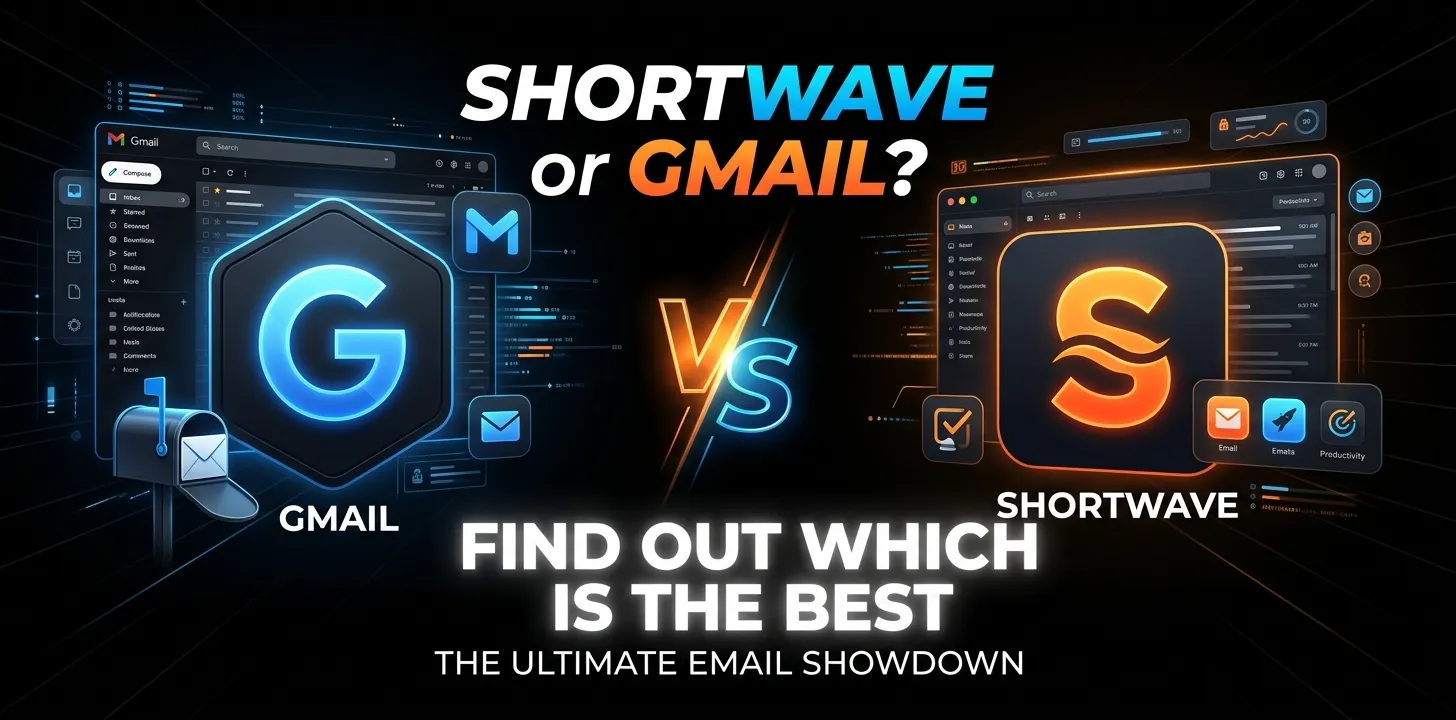
If you are choosing between Shortwave and Gmail, the better option depends on what you want from your inbox. Gmail is the stronger all-around choice for most people because it is free, widely supported, and tightly connected to Google services. Shortwave is better for users who want an AI-focused email client with advanced inbox organization, automation, and productivity tools.
Shortwave and Gmail are not quite the same type of product. Gmail is Google’s complete email service, while Shortwave is an email client designed to work with Gmail and Google Workspace accounts. That difference matters more than many feature-by-feature comparisons suggest.
Shortwave vs. Gmail at a glance
| Feature | Shortwave | Gmail |
|---|---|---|
| Main purpose | AI-powered email client | Full email service |
| Gmail support | Yes | Yes |
| Google Workspace integration | Yes | Native |
| AI features | Strong AI-first approach | Gemini features available on eligible plans/accounts |
| Inbox organization | Advanced | Strong |
| AI email search | Yes | Yes, with eligible Gemini features |
| AI writing | Yes | Yes, with eligible Gemini features |
| Multiple Gmail accounts | Yes | Yes |
| Google Drive integration | Via Google ecosystem | Native |
| Google Calendar | Integrated | Native |
| Free option | Yes | Yes |
| Best for | Email power users | Most individuals and businesses |
The biggest difference between Shortwave and Gmail
The most important distinction is simple: Gmail is the underlying email service, while Shortwave is an alternative interface for working with Gmail.
That means switching to Shortwave does not mean abandoning your Gmail account. Shortwave can import Gmail labels, filters, and other settings, and it synchronizes with Gmail.
Shortwave currently requires a Gmail or Google Workspace account to sign in. Other providers can sometimes be connected through forwarding, but Microsoft 365 and Exchange accounts are not currently supported.
So if you are looking for a replacement for the Gmail service itself, Shortwave is not really a direct replacement. It is better understood as a different way to manage Gmail.
Where Shortwave is better
Shortwave is built around the idea that your inbox should do more of the organizing for you.
Its feature set includes AI-assisted email search, automatic summaries, AI writing, natural-language filters, inbox splits, bundles, scheduling tools, follow-up reminders, and automation. It can also connect with several productivity tools.
AI-powered email management
This is probably Shortwave’s biggest advantage.
Instead of relying mainly on traditional folders, labels, and search operators, you can use AI to work with your email. Shortwave’s AI can help organize messages, search email and attachments, write responses, and create actions from natural-language instructions.
For someone who receives hundreds of work emails every week, that can be a meaningful difference.
Better inbox organization for heavy users
Shortwave offers tools such as Splits and Bundles to separate and group messages.
For example, a busy professional might want important client emails separated from newsletters, receipts, automated notifications, and internal updates. Shortwave is designed around this type of workflow.
Gmail also has powerful organization tools, including labels, filters, categories, and tabs. But Shortwave puts more emphasis on turning the inbox into a productivity workspace.
Advanced AI search
Shortwave’s AI search is aimed at questions rather than just matching keywords.
For example, instead of remembering the exact subject line of an old email, you could ask a question about information contained in your email history.
That can be especially useful when you have years of messages and attachments to search through.
Where Gmail is better
For most people, Gmail remains the easier recommendation.
It is familiar, widely supported, and deeply connected to Google’s ecosystem.
Gmail works as a complete email platform
With Gmail, you get the email service, Google Contacts, Google Calendar connections, Google Drive integration, spam protection, search, filters, labels, and access across Google’s ecosystem.
You also don’t need to learn a new email client simply to manage your messages.
A Google Account includes 15 GB of storage shared across Gmail, Google Drive, and Google Photos, with additional storage available through Google One.
Gmail has become much stronger at AI
One reason people may have considered Shortwave in the past was its emphasis on AI.
That advantage is less clear now.
Google has added Gemini-powered features to Gmail, including AI Inbox, AI summaries for email threads, AI-assisted search, and writing assistance. Availability depends on the account and plan, and some personal Gmail AI features are available in the United States.
So you should not choose Shortwave simply because you want AI in your email. Gmail already provides a growing set of AI tools.
Gmail is the safer choice for compatibility
Gmail is deeply embedded across websites, mobile apps, business services, Google Workspace, and third-party tools.
If you work with clients, businesses, schools, online services, or multiple Google products, that broad compatibility can be more valuable than having a more advanced inbox interface.
Shortwave vs. Gmail for AI
This is probably the closest part of the comparison.
| AI capability | Shortwave | Gmail |
|---|---|---|
| AI writing | Yes | Yes |
| Email summaries | Yes | Yes |
| AI email search | Yes | Yes |
| Inbox organization | Strong AI focus | Strong, with Gemini features |
| AI automation | Strong | Improving |
| Google ecosystem | Good | Excellent |
| AI-first interface | Yes | No |
Shortwave still has an important advantage for people who want their entire email workflow built around AI. Its product includes AI organization, AI filters, AI search, AI writing, scheduling, and automation rather than treating AI as an additional feature inside a traditional inbox.
Gmail has the advantage if you want AI without leaving the familiar Google environment.
Which is easier to use?
For a new user, Gmail is generally easier.
The reason is not necessarily that Gmail has fewer features. It is that most people already understand how Gmail works.
Shortwave changes the way you interact with your inbox. That can be a benefit for experienced email users, but it also means learning a new interface, workflow, shortcuts, and organization system.
If you enjoy customizing your workflow and experimenting with productivity tools, Shortwave may feel more powerful.
If you want to open your inbox and immediately know where everything is, Gmail has the advantage.
Shortwave vs. Gmail for work
For a professional who receives a large volume of email, Shortwave can be the more interesting option.
Its productivity features are designed around reducing the amount of manual inbox work. The platform includes AI-assisted search and writing, custom AI filters, scheduling, follow-up reminders, integrated calendar features, and automation options.
Consider a hypothetical freelancer who receives client requests, invoices, newsletters, meeting invitations, and project updates every day.
With Gmail, they could build filters, labels, stars, categories, and other rules to organize those messages.
With Shortwave, they can use a more automation-heavy workflow to categorize and process those messages.
The best choice depends on whether that extra workflow control is worth changing email clients.
Which is better for personal email?
For ordinary personal email, Gmail is usually the better choice.
If you mainly use email for:
- Family and friends
- Online shopping
- Travel confirmations
- Bills and receipts
- Newsletters
- Account notifications
- School communication
- Occasional work messages
Gmail already does what you need.
Paying for or learning another email client may not provide enough additional value.
Shortwave becomes more attractive when your inbox itself is a productivity problem.
Which is better for multiple Gmail accounts?
Shortwave can be useful if you manage several Gmail accounts and want a more unified productivity workflow.
Shortwave supports multiple Gmail accounts, and its paid plans are designed so additional accounts on the same device can receive the paid feature set without requiring a separate subscription for each account.
Gmail also supports multiple accounts and makes switching between them straightforward.
So the deciding factor is less about whether either product can handle multiple accounts and more about how you want those accounts organized and managed.
What about price?
Both products have free options, but their pricing models are different.
Gmail itself can be used free with a Google Account. Google also sells additional storage and AI features through Google One and Google AI plans.
Shortwave is free to get started, with paid plans adding capabilities such as broader email-history access and advanced AI features.
Because Shortwave’s plans and Google’s AI offerings can change, check the current plan details before paying for either service.
The practical question is not simply “Which is cheaper?”
It is “Will the extra productivity features save me enough time to justify paying for them?”
For a casual Gmail user, the answer is often no.
For someone spending hours every week processing email, the answer may be different.
Shortwave or Gmail: Which should you choose?
The choice becomes much easier if you match the product to your workflow.
| If you are… | Better choice |
|---|---|
| A casual email user | Gmail |
| New to email productivity tools | Gmail |
| Heavily invested in Google services | Gmail |
| Managing a large personal inbox | Shortwave |
| Looking for AI-first email management | Shortwave |
| Interested in advanced email automation | Shortwave |
| Running a Gmail-based productivity workflow | Shortwave |
| Managing email for a typical small business | Gmail or Shortwave, depending on workflow |
| Wanting the simplest option | Gmail |
| Wanting a more specialized power-user experience | Shortwave |
Frequently Asked Questions
Can Shortwave replace Gmail?
Not completely. Shortwave is an email client that works with Gmail or Google Workspace accounts, so you still need a supported Gmail-based account behind it.
Is Shortwave better than Gmail for AI?
Shortwave is better suited to people who want an AI-first email workflow, particularly for advanced search, organization, filtering, writing, and automation. Gmail also has Gemini-powered features, so the difference is now more about workflow and depth than simply having AI.
Should I switch from Gmail to Shortwave?
Switch if you regularly struggle with a large inbox and want more automation and AI-assisted organization. If you mainly need reliable email, Google integration, and a familiar interface, there is little reason to leave Gmail.
The final verdict
Gmail is the better choice for most people. It is free to start, familiar, flexible, and connected to Google’s huge ecosystem.
Shortwave is the better choice for email power users. If you spend a large part of your workday inside your inbox and want AI-assisted search, organization, writing, scheduling, and automation, Shortwave offers a more specialized experience.
There is also no need to treat the decision as permanent. Since Shortwave works with Gmail and can import Gmail settings, you can try a different workflow without abandoning your underlying Gmail account.
The practical tip is simple: if Gmail already keeps your inbox under control, stay with Gmail. If email itself has become a daily productivity bottleneck, Shortwave is worth testing.