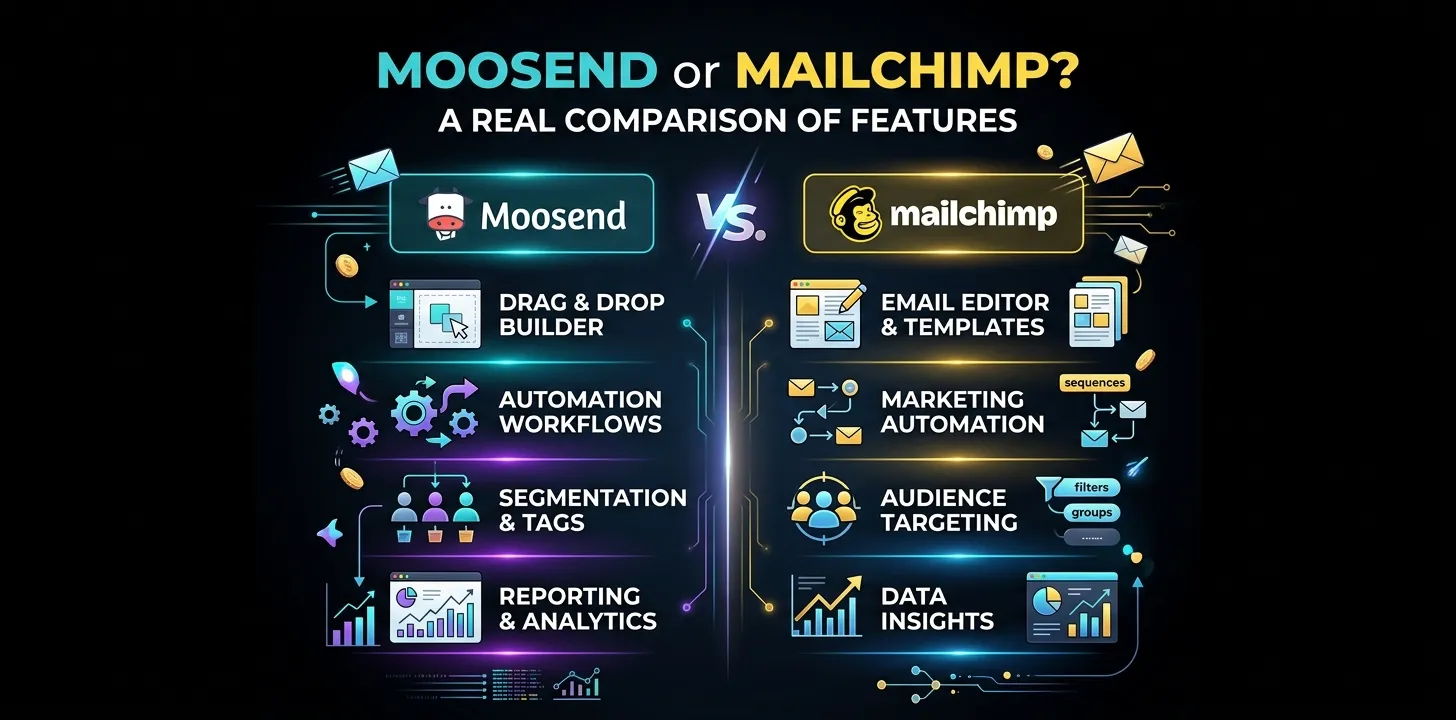
Moosend or Mailchimp? A real comparison of features

If you’re choosing between Moosend and Mailchimp, the main difference is how much marketing functionality you want for the money. Moosend focuses on email marketing, automation, segmentation, landing pages, forms, and e-commerce workflows. Mailchimp offers a broader marketing platform with a larger integration ecosystem, stronger multivariate testing, SMS options, and more advanced features on higher plans.
For a small business, online store, newsletter, or creator, both can handle the basics. The better choice depends on whether you value lower-cost automation and focused email tools or a larger marketing ecosystem with more channels and integrations.
Moosend vs Mailchimp at a glance
| Feature | Moosend | Mailchimp |
|---|---|---|
| Email campaigns | Yes | Yes |
| Drag-and-drop editor | Yes | Yes |
| Email templates | 110+ templates listed by Moosend | 100+ customizable templates |
| Segmentation | Yes | Yes |
| Personalization | Yes | Yes |
| A/B testing | Yes | Yes |
| Multivariate testing | Not a major focus | Yes |
| Marketing automation | Yes | Yes |
| Visual workflow builder | Yes | Yes |
| Landing pages | Yes | Yes |
| Signup forms | Yes | Yes |
| Transactional email | Yes | Available |
| AI tools | AI Writer and e-commerce AI tools | Generative AI features on eligible plans |
| SMS marketing | Not a core Moosend feature | Available as an add-on on paid plans |
| Integrations | Broad selection | 300+ integrations |
| Free plan | No permanent free plan is currently highlighted | Yes |
| Best fit | Email-focused businesses and automation users | Businesses wanting a broader marketing platform |
Feature availability can depend on the plan, so the table is best viewed as a high-level comparison rather than a plan-by-plan guarantee. Moosend currently lists email marketing, automation, landing pages, forms, segmentation, AI, and transactional email among its core products, while Mailchimp lists automation, templates, testing, segmentation, integrations, and additional marketing channels.
Email campaign features
Both platforms cover the basic email marketing workflow well.
You can create newsletters, promotional emails, product updates, and automated messages without building every email from HTML.
Moosend email editor
Moosend uses a drag-and-drop editor for creating emails. Its current product pages also highlight an AI Writer, customizable templates, personalization, A/B testing, reporting, and deliverability tools.
Moosend also supports several campaign types, including regular campaigns, RSS campaigns, repeatable HTML campaigns, A/B tests, automation campaigns, and transactional campaigns.
That makes it a strong option if email is the center of your marketing strategy.
Mailchimp email editor
Mailchimp also provides a drag-and-drop style email creation experience, along with pre-built and custom-coded templates. Its current feature set includes more than 100 customizable pre-built templates on paid plans, plus A/B and multivariate testing.
The difference becomes more noticeable if your team wants to experiment heavily.
Mailchimp supports testing different subject lines, content, designs, and sending times. Its multivariate testing can test up to eight campaign variations.
Winner for basic email creation: Tie
Winner for advanced testing: Mailchimp
Marketing automation
Automation is one of the most important areas in this comparison.
A good automation system lets you respond automatically when someone subscribes, opens an email, visits a page, abandons a cart, or takes another defined action.
Moosend automation
Moosend has a visual workflow builder built around triggers, conditions, and actions. Its documented automation components include page browsing, form submissions, custom events, time intervals, split flows, email campaigns, list actions, webhooks, and other workflow actions.
It also provides ready-made recipes for situations such as:
- Cart abandonment
- User onboarding
- Upselling and cross-selling
- Thank-you emails
- Re-engagement
- Reminders
- Subscriber anniversaries
This makes Moosend particularly useful for businesses that want behavioral email automation without building every workflow from scratch.
Mailchimp automation
Mailchimp also has a visual marketing automation system. Its current automation flows support multiple triggers, branches, and actions for creating personalized customer journeys. However, the exact capabilities depend on the plan.
Mailchimp’s current pricing information shows a major difference between plans. The Free plan does not include Marketing Automation Flows, while paid tiers provide progressively more automation capabilities.
Winner for automation value: Moosend
Winner for broader marketing automation ecosystem: Mailchimp
Segmentation and personalization
Sending the same email to every subscriber is rarely ideal once your list grows.
Both platforms let you divide contacts into groups and personalize campaigns.
Moosend supports segmentation, tags, custom fields, subscriber activity, and behavioral information. Its audience-management tools are designed to create custom segments and trigger automations based on individual subscriber behavior.
Mailchimp also provides audience segmentation and personalization tools. Higher-level Mailchimp features include predictive segmentation and behavioral targeting, which can be useful for businesses with larger amounts of customer data.
For a typical small business, both platforms provide enough segmentation for common use cases.
For example, a clothing store could create separate groups for:
- Customers who purchased in the last 30 days
- Subscribers who have never purchased
- Customers interested in women’s products
- Customers who abandoned their cart
- Subscribers who haven’t opened recent emails
Winner for straightforward segmentation: Moosend
Winner for advanced data-driven targeting: Mailchimp
Landing pages and signup forms
This is an area where Moosend deserves more attention.
Moosend includes landing page creation and subscription forms as part of its platform. Its landing-page builder is designed for users who want to create pages without coding, while its form tools can be used to capture new subscribers.
That can be useful for a small business running a simple funnel:
Ad → Landing page → Signup form → Automated email sequence
You don’t necessarily need separate software for each step.
Mailchimp also provides forms and landing-page tools. Its current pricing documentation confirms that even the Free plan lets users try marketing tools such as landing pages and forms.
Winner: Moosend, especially if landing pages and forms are important parts of your email workflow.
A/B testing and optimization
Both platforms support A/B testing, so you don’t have to guess which version of an email will perform better.
Moosend allows marketers to test campaign elements such as subject lines, content, and senders.
Mailchimp goes further with both A/B testing and multivariate testing. You can test subject lines, designs, content, and send times, while multivariate testing can compare multiple campaign variations.
For a small newsletter, basic A/B testing is usually enough.
For a larger marketing team that regularly runs structured experiments, Mailchimp’s broader testing capabilities are more attractive.
Winner: Mailchimp
AI features
AI is becoming a bigger part of email marketing, but the two platforms approach it somewhat differently.
Moosend currently promotes an AI Writer along with AI-powered product recommendations and audience discovery tools.
Mailchimp offers generative AI features on eligible plans and also provides predictive segmentation and other data-driven marketing capabilities.
The practical difference is less about whether either platform has AI and more about what you want AI to do.
If you mainly want help writing email copy and working with e-commerce campaigns, Moosend has useful tools built into its email-focused platform.
If you want AI tied into a broader marketing and customer-data system, Mailchimp has the stronger overall platform.
Winner: Mailchimp for breadth; Moosend for focused email use.
E-commerce features
Both platforms can work with online stores, but this is an important area to examine before choosing.
Moosend specifically highlights e-commerce automation, behavioral tracking, product recommendations, cart abandonment, and upsell/cross-sell workflows.
That makes it a natural fit for an online store that wants automated email sequences.
For example, a hypothetical Shopify store could use an automation like:
- Customer views a product.
- Customer adds the product to the cart.
- Customer leaves without buying.
- Automated reminder is sent.
- Customer purchases.
- Follow-up email recommends a related product.
Mailchimp also supports e-commerce marketing and has a much larger integration ecosystem. Its current platform lists 300+ integrations, which can make it easier to connect marketing activity with other business software.
Winner for focused e-commerce automation: Moosend
Winner for broader e-commerce ecosystem: Mailchimp
Integrations
This is one of the clearest advantages for Mailchimp.
Mailchimp currently lists 300+ integrations, giving businesses a large selection of ways to connect their email marketing with other services.
That matters when your business already depends on several tools.
For example, a company may need its email platform to work with an e-commerce system, CRM, accounting software, analytics tools, advertising platforms, and other applications.
Moosend also supports integrations and provides an API, but its ecosystem is not as large as Mailchimp’s.
If you need a very specific third-party connection, Mailchimp is more likely to have an established integration.
Winner: Mailchimp
Reporting and analytics
Both platforms provide reporting tools to help you understand campaign performance.
Moosend provides real-time reports and automation analytics. Its automation reporting can show recipient activity, clicks, and other campaign metrics directly within the workflow environment.
Mailchimp provides campaign reporting and broader marketing analytics. Depending on the plan, users can access features such as custom reports and predictive tools.
For basic questions such as “Did people open and click my campaign?”, either platform can work.
For businesses that want deeper reporting across a broader marketing operation, Mailchimp has more room to grow.
Winner for simple automation reporting: Moosend
Winner for broader marketing analytics: Mailchimp
Pricing and free plans
Pricing can change the answer quickly, especially for a growing email list.
Mailchimp currently has a permanent Free plan for up to 250 contacts and 500 sends per month, with a daily limit of 250 sends. The Free plan also limits users to one audience and one seat.
Mailchimp’s paid plans increase sending capacity and add features such as more automation, users, audiences, reporting, and support.
Moosend takes a different approach. Its current platform emphasizes a free trial and paid email marketing service rather than the same permanent free model offered by Mailchimp. Its product pages currently promote unlimited email campaigns/sends, automation, landing pages, forms, A/B testing, reporting, and SMTP as core capabilities.
Third-party software comparison data currently lists Moosend’s starting price lower than Mailchimp’s, although actual pricing depends on the number of contacts, billing terms, and current plan structure.
So the simple way to think about pricing is:
- Very small list and zero budget: Mailchimp has the advantage because of its permanent Free plan.
- Growing list with heavier email use: Moosend can offer stronger value.
- Business needing multiple marketing channels: Mailchimp may justify the higher cost through its broader feature set.
Ease of use
Both platforms are designed for marketers rather than developers.
Moosend’s visual workflow builder uses drag-and-drop controls and lets users build automations without coding.
Mailchimp is also designed to make campaign creation accessible to beginners. Its large ecosystem can actually make it feel more complex as you move into advanced features.
For someone who only wants to send a weekly newsletter, either platform should be manageable.
For someone building several behavioral automations, Moosend’s focused interface may feel easier because the platform is heavily centered around email and automation.
Winner for focused email workflows: Moosend
Winner for familiar all-in-one marketing tools: Mailchimp
Which one is better for different users?
The best choice changes depending on what you are actually trying to accomplish.
| If you are… | Better choice |
|---|---|
| Starting with fewer than 250 contacts | Mailchimp |
| Looking for a permanent free plan | Mailchimp |
| Building advanced email workflows on a budget | Moosend |
| Running an email-focused small business | Moosend |
| Running an online store with automated email campaigns | Moosend |
| Needing hundreds of integrations | Mailchimp |
| Wanting SMS as part of your marketing platform | Mailchimp |
| Running lots of campaign experiments | Mailchimp |
| Wanting landing pages and forms alongside email | Moosend |
| Wanting a larger all-in-one marketing ecosystem | Mailchimp |
Moosend vs Mailchimp: which one should you choose?
Choose Moosend if your main goal is email marketing and automation and you want a focused platform with segmentation, landing pages, forms, behavioral workflows, A/B testing, and e-commerce automation.
Choose Mailchimp if you want a larger marketing ecosystem, a permanent free plan for a very small list, a much larger integration library, advanced testing, SMS options, and more features available as your marketing operation grows.
For a small business with a growing list, I would not choose based only on the free plan. A free account is useful, but your long-term workflow matters more. If automation is central to your marketing, compare what you can actually build at the plan level you expect to use.
FAQ
Is Moosend better than Mailchimp for automation?
Moosend is a strong choice when automation is the main priority because its platform puts visual workflows, behavioral triggers, segmentation, and automation recipes at the center of the product. Mailchimp also has powerful automation, but access and capabilities vary more by plan.
Does Mailchimp have a better free plan than Moosend?
Mailchimp has the clearer advantage if you specifically need a permanent free plan. Its current Free plan supports up to 250 contacts and 500 email sends per month, while Moosend primarily promotes a free trial rather than the same type of ongoing free tier.
Which is better for a small online store, Moosend or Mailchimp?
Moosend is worth considering if your priority is automated e-commerce email, such as cart abandonment, product follow-ups, and upselling. Mailchimp may be a better fit if your store depends on many third-party applications or you want email alongside a broader marketing ecosystem.
Final verdict
Moosend and Mailchimp are both capable email marketing platforms, but they are built around slightly different priorities.
Moosend stands out for focused email marketing, automation, segmentation, landing pages, forms, and e-commerce workflows. Mailchimp stands out for its larger integration ecosystem, free entry tier, broader marketing features, advanced testing, and additional channels.
If you’re choosing purely on email automation and value, Moosend deserves a close look. If you want a broader marketing platform that can connect with a large collection of business tools, Mailchimp is the safer choice.
The practical move is to map your next six to twelve months of email marketing needs—not just your needs today—and choose the platform whose plan and features fit that workflow.